Who Really Gave Britain the Christmas Tree? Not Who You Think
Prince Albert gets the credit, but a German-born queen set up Britain's first royal Christmas tree nearly fifty years before he was even born.
Every December, some version of the same fact does the rounds: Prince Albert brought the Christmas tree to Britain, a homesick German import that charmed a nation into copying it. It is a tidy story. It is also only half true.
The real history starts nearly fifty years earlier, in a different reign entirely, with a different German-born royal who has never quite got her due. Who invented the Christmas tree in Britain is a more interesting question than the popular version lets on, and the answer says as much about the power of a single well-timed image as it does about who actually put up the first tree.
Where the tradition actually began, long before either royal
Neither Charlotte nor Albert invented the decorated tree itself; they were both drawing on a custom already centuries old in German-speaking Europe. There’s a reference to a decorated tree among the Freiburg Fraternity of Baker’s Apprentices in Alsace as early as 1419, and by the mid-1500s the practice was recognisably established within German Lutheran tradition, with the earliest Tannenbaum songs already being written by around 1550.
The candles are usually credited to Martin Luther, the Protestant reformer, who is widely believed to have been the first to add lit candles to a tree, meant to represent Christ as the light of the world. By the 17th century, the custom was well established among Protestant families in regions including Alsace, Baden and Hesse, and by the following century it had spread to major cities such as Berlin and Hamburg, complete with “paradise trees” hung with sweets, flowers and coloured paper. Both Charlotte and Albert grew up with a tradition that was already old news at home. What was missing was Britain.
The story everyone tells
The popular version goes like this: Prince Albert, Queen Victoria’s German husband, arrived in Britain in 1840 carrying the customs of his Coburg childhood, among them the tradition of decorating a fir tree with candles and small gifts. Charmed and homesick, he introduced it to the royal household, the country fell in love with the novelty, and the British Christmas tree was born.
It is easy to see why the story stuck. Albert was genuinely devoted to German Christmas customs, and he did bring real energy to how the royal family celebrated the season. But “introduced” is doing more work in that sentence than the facts support.
The real first royal Christmas tree, 1800
Queen Charlotte, the German-born wife of George III and Victoria’s own grandmother, set up the first documented royal Christmas tree in Britain at Windsor’s Queen’s Lodge in December 1800, decades before Albert was born. Charlotte, who came from Mecklenburg-Strelitz in northern Germany, brought the custom with her as a matter of personal tradition, decorating a yew branch for a children’s party at the Lodge.
It was, by contemporary accounts, a modest domestic gesture rather than a national event: a German-born queen keeping a piece of home alive for her own household. There was no engraving, no press coverage, no sudden fashion for trees among the upper classes. The custom stayed largely within court circles for the best part of half a century, admired by those who saw it but never widely imitated.
So why does Albert get the credit?
Albert’s real contribution wasn’t invention. It was amplification, arriving at exactly the right cultural moment. By the 1840s, Victorian Britain had a mass-circulation illustrated press hungry for images of the young royal family, and a growing middle class eager to copy whatever that family did. Albert and Victoria didn’t just have a tree; they had a decorated tree at Christmas that somebody eventually thought to draw and publish.
That single decision, to illustrate the domestic scene rather than simply describe it, is the entire reason one royal is remembered as “inventing” a tradition that another royal had quietly kept for fifty years.
The 1848 illustration that changed everything
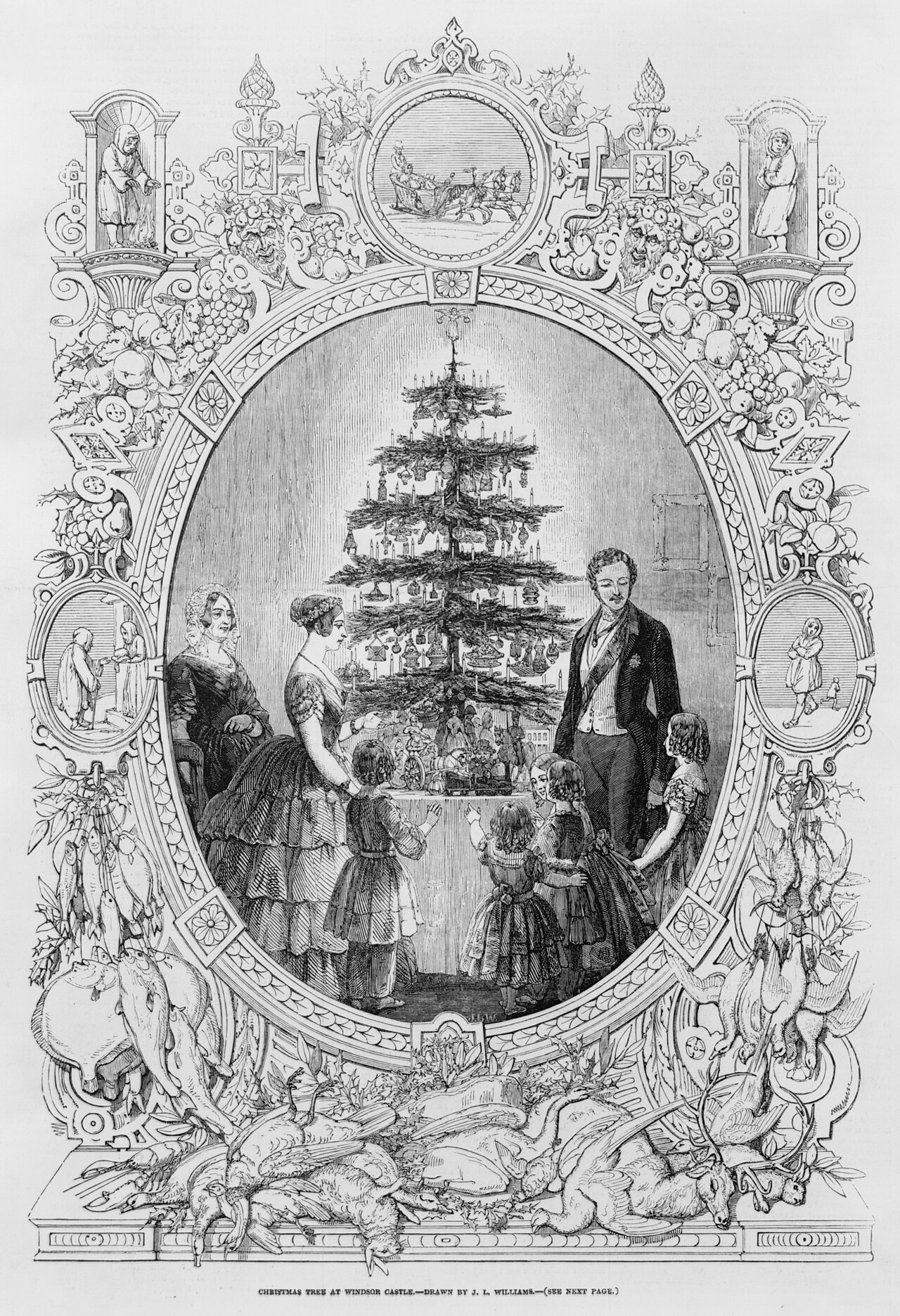
On 23 December 1848, the Illustrated London News published a full-page wood engraving, drawn by J. L. Williams, on the cover of its Christmas Number: Victoria, Albert, their five children at the time, and Victoria’s mother, gathered around a candlelit tree decorated with glass ornaments at Windsor Castle, framed by an oval border of winter scenes and a bountiful harvest. It is the image still reproduced every December, and it did more for the British Christmas tree in one printing run than fifty years of quiet royal tradition had managed.
Contemporary accounts describe the image as an outright sensation on publication, printed alongside a detailed description of the ornaments themselves. By the 1840s, the illustrated press was booming, the public was fascinated by the young Queen’s domestic life, and the middle class had both the money and the appetite to copy royal taste. Unlike Charlotte’s private party at the Lodge, this was a mass-produced image. It was in homes across the country within days.
How a picture became a national habit
The effect was immediate and lasting. Middle-class households up and down Britain started setting up their own decorated trees within a season or two; the look quickly became the fashionable, family-centred way to mark Christmas. By the end of the 1850s, the tree had gone from a curiosity glimpsed at court to a fixture of the British Christmas, crossing class lines in a way Charlotte’s original tree never got the chance to.
A single published image did that: not legislation, not a sermon, not a royal decree, inside a single decade. Royal habit started it, but it was Victorian print media that actually spread it.
The tree crosses the Atlantic too
The same engraving’s influence didn’t stop at the English Channel. Around 1850, the American magazine Godey’s Lady’s Book reprinted a version of the 1848 image for its own readers, effectively introducing the custom to much of English-speaking America at the same moment it was taking hold across Britain. A single Windsor Castle illustration, drawn for one country’s Christmas Number, ended up quietly shaping how two nations came to picture the holiday.
What Charlotte’s tree actually looked like
Descriptions of Charlotte’s 1800 gathering suggest something far simpler than the elaborate, candlelit tableau of the 1848 engraving: a single yew branch, decorated for a children’s party, not a grand household display. It was a private comfort from her German upbringing, not a public gesture.
That contrast is why one tree became legend and the other a footnote. Scale mattered, and audience mattered, but what mattered most was that someone thought to record and publish the moment.
Why the myth (and the real story) still matter
There is something rather lovely about the accurate version of this story: two German-born queens, two generations apart, both quietly keeping a piece of home alive inside the British court, with one of them getting the credit largely by historical accident. Charlotte planted the custom. Victoria and Albert’s household, immortalised by one engraving, gave it to the nation, and an ocean away, an American magazine passed the same image on again.
Both versions of the story are, in their way, true to what the Christmas tree still represents: a small, warm, domestic ritual, imported by people far from their own childhood homes, that ended up belonging to everyone. Browse more of our Royal Places & Events stories for the history behind Britain’s best-loved festive traditions.
Frequently asked questions
Who really introduced the Christmas tree to Britain?
Queen Charlotte, the German-born wife of George III, set up the first documented royal Christmas tree at Windsor’s Queen’s Lodge in December 1800, nearly fifty years before Prince Albert, who is popularly credited with the tradition, was even born.
Did Prince Albert bring the Christmas tree to Britain?
Not originally, but he and Queen Victoria are correctly credited with popularising it nationally. An 1848 engraving of their family around a decorated tree at Windsor Castle, published in the Illustrated London News, made the custom fashionable across the country within a decade.
Where does the Christmas tree tradition actually come from?
German-speaking Europe, with references dating back as far as 1419 in Alsace and an established custom by the mid-1500s, including the tradition of candles, widely credited to Martin Luther, representing Christ as the light of the world.
What was in the famous 1848 Christmas tree illustration?
The engraving, drawn by J. L. Williams and published on the Illustrated London News’s Christmas Number cover on 23 December 1848, shows Queen Victoria, Prince Albert, their five children at the time, and Victoria’s mother gathered around a candlelit tree decorated with glass ornaments at Windsor Castle.
Why is Queen Charlotte’s Christmas tree less well known?
Charlotte’s 1800 tree was a private, modest gathering, a decorated yew branch for a children’s party at Windsor’s Queen’s Lodge, with no illustration or press coverage. It stayed largely within court circles, unlike the widely reproduced 1848 image of Victoria and Albert’s family.
Did the 1848 engraving influence Christmas trees outside Britain too?
Yes. Around 1850, the American magazine Godey’s Lady’s Book reprinted the same image, helping introduce the custom to English-speaking America at roughly the same time it was spreading across Britain.
When did the Christmas tree become popular across Britain?
The custom spread rapidly among the middle classes in the years immediately following the 1848 Illustrated London News engraving, and was an established fixture of the British Christmas by the end of the 1850s.
Historical details are drawn from the Royal Collection Trust (rct.uk), the Library of Congress, contemporary accounts of the 1800 and 1848 gatherings, and the Illustrated London News archive; described as of 2026.