The Vladimir Tiara: A Jewel That Escaped a Revolution
Smuggled out of a Russian palace in a Gladstone bag and sold to Queen Mary in exile: the extraordinary journey of one of the royal family's most travelled tiaras.
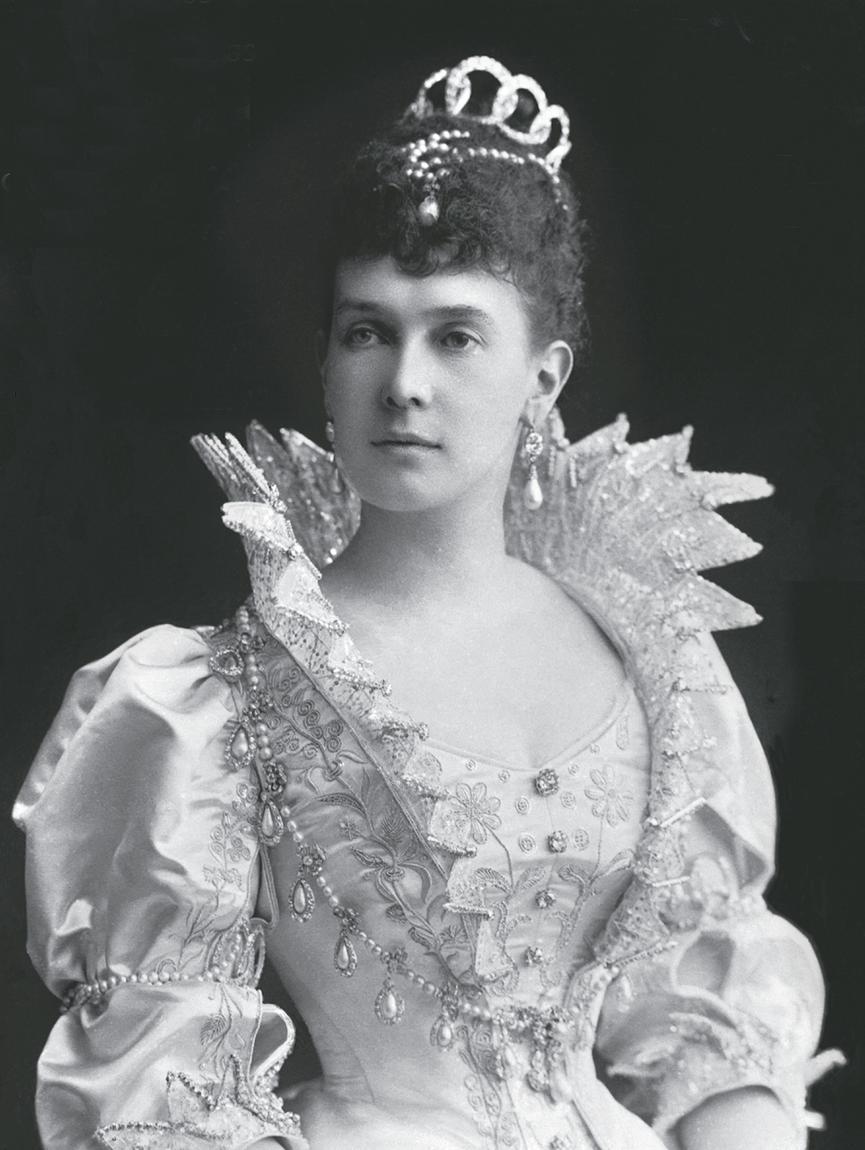
Some jewels are beautiful; a few are also survivors. The Vladimir Tiara, a cascade of interlaced diamond circles, today one of the most recognisable pieces in the royal collection, owes its place in Britain to one of the most dramatic rescue stories in the history of jewellery.
Grand Duchess Maria Pavlovna: The Woman Who Wore It
To understand the Vladimir Tiara is first to understand the woman for whom it was made. Grand Duchess Maria Pavlovna of Russia, born a Princess of Mecklenburg-Schwerin and known at court simply as Grand Duchess Vladimir, after her husband Grand Duke Vladimir Alexandrovich, was among the most formidable figures in Romanov society. Tall, imperious, and possessed of a theatrical intelligence, she ran the Vladimir Palace in St Petersburg as a rival court to that of her nephew Tsar Nicholas II, and she wore the role with relish.
Her entertainments were legendary. Ambassadors, artists, and grand dukes competed for invitations to her dinners and balls. She was a patron of the arts who helped shepherd Diaghilev and the Ballets Russes into being; she commissioned portraits, collected silver, and accumulated jewels with the connoisseurship of a woman who regarded beauty as a serious occupation. The Vladimir Tiara, delivered by Bolin in the 1870s or 1880s, was the crown of her collection, and she was photographed wearing it with the particular satisfaction of someone who knows a masterpiece when they own one.
The House of Bolin: Imperial Jewellers of the First Rank
The tiara itself was the work of the house of Bolin, one of the great imperial court jewellers of nineteenth-century Russia. Founded by a Swedish goldsmith, the firm established itself in Moscow and St Petersburg across several generations, producing work for the Romanov court with the same combination of technical ambition and restrained magnificence that made Russian imperial jewellery the envy of Europe.
Bolin’s commissions ranged from parures for grand duchesses to gifts for the imperial family, and they were rivals of equal distinction to the celebrated house of Fabergé. The Vladimir Tiara exemplifies what made Bolin exceptional: the fifteen interlocking diamond circles, a motif drawn from classical antiquity, are executed with a lightness that belies the weight of stones involved, each circle articulated so that the whole piece moves with the wearer rather than sitting as a rigid crown. That subtle engineering, as much as the brilliance of the diamonds themselves, is what separates a great jewel from a merely expensive one.
The Vladimir Palace and Its Treasures
The Vladimir Palace on the Palace Embankment was one of the grandest private residences in imperial St Petersburg, and Grand Duchess Maria Pavlovna filled it accordingly. Its interiors ran to Moorish smoking rooms, Gothic dining halls, and state apartments hung with paintings that rivalled those of the Hermitage a short distance along the river. The jewel collection was kept in a concealed safe, not from any particular fear of theft, but because in the world of Russian grand ducal life, one’s jewels were assets as much as adornments, and they were guarded with corresponding seriousness.
When the Revolution came in 1917, the Grand Duchess managed to escape. Unlike so many of the Romanovs, she survived, crossing eventually to the Caucasus and from there into Western Europe. She died in 1920 in Contrexéville, France, having spent her final years in the genteel poverty of exile. The jewels, however, had been left behind in the safe at the Vladimir Palace, and their fate hung in the balance of a changed world.
The Rescue: Bertie Stopford and a Gladstone Bag
The story of how the jewels were saved belongs chiefly to Bertie Stopford, an English art dealer and man-about-society who had spent years moving in Russian aristocratic circles and who possessed, at the critical moment, both the nerve and the access to act. In an episode that reads more like an adventure novel than a chapter of jewellery history, Stopford, with the assistance of Grand Duke Boris, slipped back into the Vladimir Palace in the early days of revolutionary disruption, located the concealed safe, and removed its contents.
The jewels travelled out of Russia in Gladstone bags: heavy leather holdalls of the kind that Victorian doctors carried on house calls, unremarkable in appearance and capacious enough to swallow a fortune in diamonds without arousing visible suspicion. Exactly how the bags crossed the border is a matter of competing accounts, but cross it they did, arriving eventually in London. It was a piece of audacity that saved not just the Vladimir Tiara but a substantial portion of Grand Duchess Maria Pavlovna’s collection from almost certain confiscation.
Queen Mary and the Acquisition of 1921
By 1921, the tiara had reached the hands of Princess Nicholas of Greece and Denmark, born Princess Elena Vladimirovna, daughter of Grand Duchess Maria Pavlovna, who was living in exile and in reduced circumstances along with most of the surviving Romanov diaspora. She sold the tiara, which had been damaged during its travels, to Queen Mary of Great Britain.
Mary was an extraordinarily perceptive collector, particularly of Russian imperial jewellery. She understood its provenance, its rarity, and its pathos. A generation of the most spectacular jewels in the world was coming onto the market as dispossessed aristocrats quietly sold what they had managed to salvage, and Mary bought thoughtfully and well. The tiara went to Garrard, the Crown Jeweller, for careful restoration. A piece born in one imperial court had found its way, intact, into another.
The Cambridge Emeralds: A Marriage of Two Inheritances
Queen Mary’s genius for the Vladimir Tiara lay not simply in acquiring it but in what she did next. In 1924 she had the tiara converted by Garrard so that the original swinging pearl drops could be replaced, whenever the occasion demanded, with a set of magnificent emerald drops known as the Cambridge emeralds.
The Cambridge emeralds had their own long history. They had been part of the collection of Augusta of Hesse, whose daughter Princess Mary Adelaide of Cambridge, Queen Mary’s mother, brought them to Britain. They passed eventually to Queen Mary herself, and she saw, with the eye of a great collector, that their deep green fire would transform the Vladimir Tiara into something entirely different from its pearl incarnation. Garrard built a mechanism that allowed the drops to be changed with ease: a technical feat of convertibility that effectively gave the Royal Family three tiaras in one: pearls, emeralds, or the bare diamond circlet worn without any drops at all.
Two Looks, One Frame: Pearls and Emeralds
The visual difference between the two modes is more than a matter of colour. Worn with its pearl drops, the Vladimir Tiara has an antique, almost Edwardian gravity: the creamy white pendants echo the diamonds above them, creating a monochrome palette of great refinement. It reads as a piece of its era, connected to the Russian imperial world that produced it.
With the emerald drops in place, the tiara becomes something bolder and more vivid. The deep green of the Cambridge emeralds introduces a colour contrast that gives the piece a modern visual energy. The same diamond structure suddenly feels less like an heirloom and more like a statement. The emeralds are larger and more assertive than the pearls, and they swing with a particular authority. It is a testament to Bolin’s original design that the frame carries both looks with equal conviction.
Queen Elizabeth II and the Vladimir Tiara
Queen Elizabeth II wore the Vladimir Tiara across six decades of her reign, reaching for it with a frequency that suggests a genuine fondness rather than mere rotation. She wore it with the pearls at numerous state banquets, and with the emeralds on occasions that called for something more vivid: state visits, formal receptions, and evenings when the diamonds alone were not quite enough.
Photographs from across her reign show the tiara adapted to different contexts with a consistency that reveals her confidence in it. It suited her: the interlocked circle motif is strong without being imposing, and the tiara sits at a height that complements rather than overwhelms. She wore it as a working jewel: present, purposeful, and entirely at ease.
The Tiara Today
The Vladimir Tiara remains an active piece in the Royal Collection, and it is King Charles III’s Queen, Camilla, who wears it most frequently today. She has been photographed in it on several formal occasions since 2022, and she has shown a particular affinity for the emerald configuration, the green drops suiting her colouring and her preference for jewels with some visual weight behind them. The tiara has, in this way, continued its pattern of finding the right wearer at the right moment.
Its survival, from the Vladimir Palace to a Gladstone bag, from a Paris auction to Garrard’s workshop, from Queen Mary’s dressing table to Buckingham Palace, stands as a reminder that the most enduring jewels are not always those that passed through the most ordered hands.
A Survivor, Above All
What distinguishes the Vladimir Tiara from almost every other piece in the Royal Collection is the nature of its journey. Most great tiaras were commissioned in tranquillity, worn in ceremony, and descended through generations in uninterrupted splendour. The Vladimir Tiara was made in one empire, survived the collapse of that empire by the slimmest of margins, crossed a continent in a Gladstone bag, changed hands in exile, and arrived in Britain repaired and reinvented. It then outlasted the century that had tried to erase the world it came from.
When it appears at a state banquet today, blazing under chandeliers with its Cambridge emeralds in place, it carries all of that history with it: the Grand Duchess who commissioned it, the art dealer who rescued it, the queen who reimagined it, and the revolution it survived. Some jewels are beautiful; a few are also survivors. The Vladimir Tiara is both.
Details of the tiara’s history are drawn from widely published accounts; some specifics vary between sources.
Frequently Asked Questions
Who made the Vladimir Tiara?
The tiara was made by Bolin, a distinguished imperial court jeweller based in St Petersburg and Moscow, for Grand Duchess Maria Pavlovna (Grand Duchess Vladimir) in the 1870s or 1880s.
How did the Vladimir Tiara get to Britain?
Following the Russian Revolution, the tiara was recovered from a concealed safe in the Vladimir Palace by the English art dealer Bertie Stopford and Grand Duke Boris, smuggled out of Russia in Gladstone bags, and eventually sold by Princess Nicholas of Greece, daughter of the original owner, to Queen Mary in 1921.
What are the Cambridge emeralds?
The Cambridge emeralds are a set of large emerald drops that originally formed part of the jewel collection of Augusta of Hesse. They passed to Queen Mary through her mother, Princess Mary Adelaide of Cambridge, and were adapted by Garrard in 1924 to hang from the Vladimir Tiara as an alternative to its original pearl drops.
Can the Vladimir Tiara be worn in different ways?
Yes. Queen Mary had Garrard build a mechanism in 1924 that allows the tiara to be worn with its original pearl drops, with emerald drops (the Cambridge emeralds), or with no drops at all, effectively making it three distinct jewels in a single frame.
Did Queen Elizabeth II wear the Vladimir Tiara often?
Yes. Queen Elizabeth II wore it frequently across her reign in all three configurations, with pearls, emeralds, and without drops, at state banquets and formal occasions. It was among the most reliably worn tiaras in her collection.
Who wears the Vladimir Tiara now?
Since 2022, Queen Camilla has worn the Vladimir Tiara on several state occasions. She has shown a particular preference for the emerald configuration.
What happened to Grand Duchess Maria Pavlovna?
Grand Duchess Maria Pavlovna escaped Russia following the Revolution and died in Contrexéville, France, in 1920, having spent her final years in exile. She did not live to see her jewels safely recovered, though her children managed to salvage much of the collection.
Where is the Vladimir Tiara kept today?
The Vladimir Tiara is part of the Royal Collection and remains in active use by the Royal Family. It is not on permanent public display, though it appears regularly at state events.


