The Crown, the Orb and the Sceptre: The Regalia at Queen Elizabeth II's Funeral
Three pieces of the Crown Jewels rode atop the late Queen's coffin, and their removal at the very end was one of the most moving moments of all.
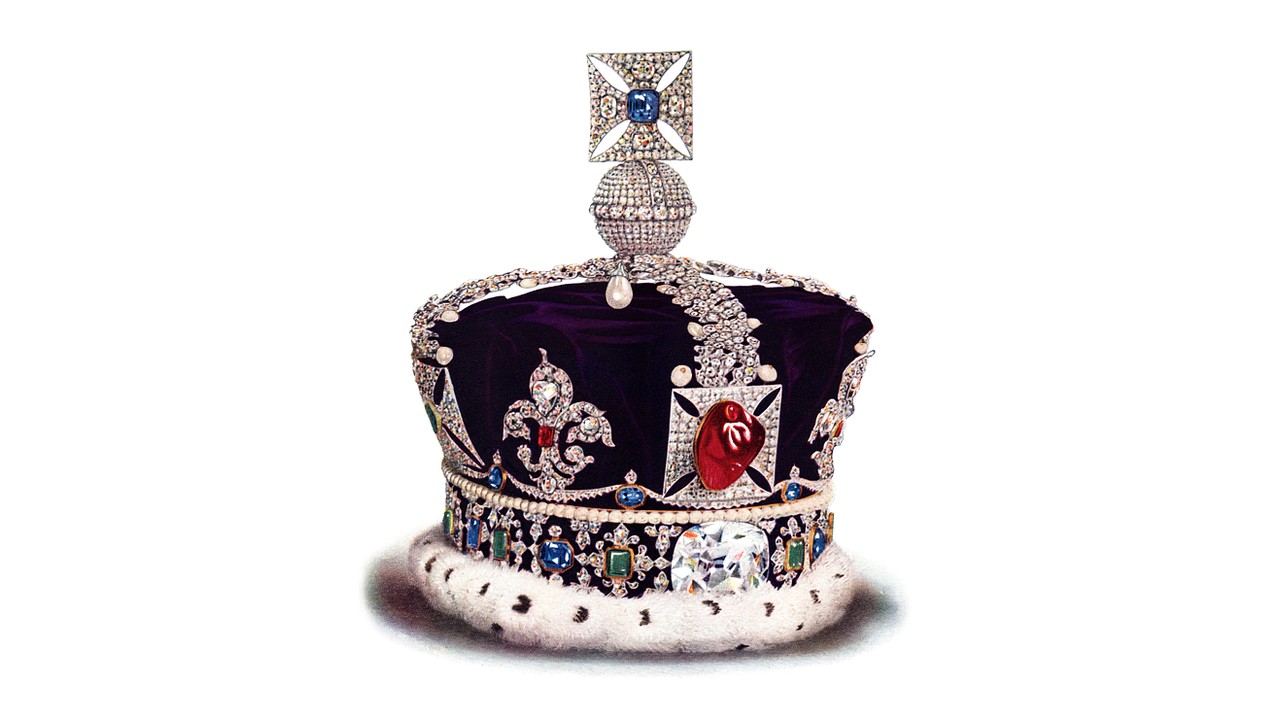
When Queen Elizabeth II was laid to rest in September 2022, three of the most significant objects in the nation rode with her: the Imperial State Crown, the Sovereign’s Orb and the Sovereign’s Sceptre, resting atop her coffin. Each is a piece of the working Crown Jewels, and each carried a meaning that made the final moments of the day almost unbearably poignant.
The Crown Jewels: a treasure seven centuries in the making
The Crown Jewels are kept in the Jewel House at the Tower of London, one of the most visited attractions on earth, and for good reason. They represent an unbroken tradition of British monarchy stretching back to the medieval period, although the collection as it exists today dates principally from 1661, when Charles II commissioned a new set of regalia following the destruction of the earlier pieces under the Commonwealth. Oliver Cromwell had ordered the ancient crowns and sceptres melted down and sold; at the Restoration, they had to be made afresh.
Today the collection numbers some 140 objects, including crowns, orbs, sceptres, swords, spurs, and rings. They are housed in the Waterloo Block at the Tower and see active ceremonial use at coronations and, until 2022, at State Openings of Parliament. When they leave the Tower for such occasions, they travel under heavy security, sometimes in purpose-built conveyances. For the coronation of King Charles III in 2023, they were carried in dedicated vehicles as part of a procession that the public has come to regard as one of the great spectacles of British national life.
For Queen Elizabeth II, these objects were more than national treasures. They were the instruments of her own calling: the very items that had been placed in her hands and upon her head at Westminster Abbey on 2nd June 1953.
The regalia upon the coffin
Throughout the lying-in-state at Westminster Hall and the funeral at Westminster Abbey, the three pieces sat together on the Queen’s coffin, on a velvet cushion above the Royal Standard. Placed there, they were not ornament but symbol: the visible signs of the sovereign’s authority, accompanying the longest-reigning monarch in British history one last time.
The Imperial State Crown in detail
The Imperial State Crown is the crown the Queen wore as she left her coronation and at each State Opening of Parliament, the one most people picture when they think of her. The present crown was made in 1937 for the coronation of George VI, but was altered for Elizabeth II’s coronation in 1953: the headband was reduced in size to fit her, and certain stones were reset to suit the lighter, more elegant proportions that would work with televised ceremonial.
The crown blazes with some of the most storied stones in the world. At its front sits the Black Prince’s Ruby, a large irregular spinel (not technically a ruby at all) with a history stretching back to 1367, when it was given by Pedro of Castile to Edward, the Black Prince. It was reportedly worn by Henry V at Agincourt. At the back of the crown rests the Stuart Sapphire, a large oval blue stone that can be traced to the Stuart kings and was brought back to England after the exiled James II died in France. High in the cross at the crown’s summit sits the tiny St Edward’s Sapphire, reputed to have come from the coronation ring of Edward the Confessor. And dominating the centre of the base, catching every camera flash in the Abbey, is the Cullinan II diamond, also called the Second Star of Africa, a 317.4-carat cushion-cut stone that is the fourth-largest polished diamond in the world. It was cut from the Cullinan diamond, found in South Africa in 1905 and presented to Edward VII.
To see this crown resting on the Queen’s coffin was to see seventy years of parliamentary openings, seven decades of the speech from the throne, collapsed into a single, still image.
The Sovereign’s Orb: Christian sovereignty made tangible
The golden Sovereign’s Orb, topped with a cross, is among the oldest symbolic forms in European monarchy. At the coronation, it is placed in the new sovereign’s right hand and then transferred to the altar. The gesture signifies that the orb, and thus the world, is held only temporarily in the monarch’s keeping. The orb represents the Christian world: the sphere of the earth beneath the cross of Christ, declaring that the sovereign’s power is derived from, and answerable to, a higher authority.
The current Sovereign’s Orb was made for Charles II’s coronation in 1661, and has been used at every British coronation since. It stands approximately 27 centimetres tall and weighs just over 1.3 kilograms, though in the hands of the sovereign it carries rather more than that. At the coronation of Queen Elizabeth II, the Archbishop of Canterbury placed it in her hands with the words: “Receive this Imperial Robe, and the Orb set under the Cross, and remember that the whole world is subject to the Power and Empire of Christ our Redeemer.” On the coffin, it spoke of a faith that the Queen held quietly, privately, and with absolute constancy throughout her life.
The Sovereign’s Sceptre with Cross: the Great Star of Africa
The Sovereign’s Sceptre with Cross represents the monarch’s temporal power, the governance of the realm, and it contains one of the most breathtaking gemstones anywhere on earth. Set into the head of the sceptre is the Cullinan I diamond, known as the Great Star of Africa: a pear-shaped brilliant of 530.2 carats, the largest colourless cut diamond in the world. Like its companion stone in the Imperial State Crown, it was cut from the Cullinan rough in 1908.
The sceptre itself was made in 1661, but was remade to accommodate the Cullinan I after the stone’s gift to the Crown in 1907. The setting was redesigned so that the diamond can, in theory, be removed and worn as a brooch. At the coronation it is placed in the sovereign’s right hand at the moment of investiture, the Archbishop declaring it the rod of equity and mercy. As it rested on the coffin, it stood for every Act of Parliament signed, every audience given, every constitutional duty discharged without question or complaint across seven decades.
The Sovereign’s Sceptre with Dove: the rod of equity
Less often remarked upon, but also present at the funeral, was the Sovereign’s Sceptre with Dove, sometimes called the Rod of Equity and Mercy. Where the Sceptre with Cross represents power, the Sceptre with Dove represents mercy and the spiritual dimension of the sovereign’s role. Topped with an enamelled dove with outstretched wings, the symbol of the Holy Spirit, it is placed in the new sovereign’s left hand at the coronation. Together, the two sceptres make a complementary pair: might and mercy, authority and grace. Both objects rode atop the coffin, a pairing that will have been noted by anyone familiar with the choreography of a coronation.
The vigil of the princes
On the evening of 17th September 2022, as the Queen lay in state at Westminster Hall, the four adult grandsons of the Queen (the then-Prince of Wales, Prince Harry, Peter Phillips, and the then-Earl of Snowdon) mounted a vigil around the coffin in full military dress or Highland morning coat, standing at the corners of the catafalque, heads bowed, for fifteen minutes of public silence.
The sight was profoundly moving: four men who had grown up in the long shadow of the Crown, standing guard over the grandmother who had been, for most of their lives, one of the most recognisable figures in the world. The regalia on the coffin between them glittered even in that muted ceremonial light, and the vigil bridged the personal and the constitutional in a way that a formal service alone could not.
The journey from the Tower
The passage of the regalia from the Tower of London to ceremonial venues and back is itself a matter of considerable tradition. For the Queen’s funeral, the Crown, Orb, and Sceptre were brought from the Tower to Westminster Hall on the day the coffin arrived, where they were placed on their cushion by royal household staff. They then accompanied the coffin to Westminster Abbey and subsequently to Windsor.
For a coronation, the process is even more elaborate: each piece travels under armed escort, the cases purpose-built, the handovers governed by centuries-old protocol. After every use, the jewels return to the Jewel House, where they continue to draw millions of visitors each year. The Tower wardens, the Yeomen Warders, are formally responsible for their safekeeping, a duty that has been continuous since the Norman period.
The committal: the Lord Chamberlain breaks his wand
The most moving moment came at the committal service in St George’s Chapel, Windsor. Near the end, the Crown, Orb and Sceptre were carefully removed from the coffin and placed on the altar, separating the Queen, for the first and final time, from the symbols of the Crown she had carried since 1952. The Crown would pass on; Elizabeth, the woman, would not need it where she was going.
Then the Lord Chamberlain, the Baron Parker of Minsmere, broke his Wand of Office and laid it on the coffin. This ancient gesture, the deliberate snapping of a white staff, signals the formal end of an official’s service to the sovereign. It descends from medieval court practice and was last performed publicly at the funeral of George VI in 1952. In 2022, it was broadcast to a global audience of hundreds of millions, many of whom were encountering the tradition for the very first time. The broken wand is not replaced; it is laid with the sovereign as a token of completed service. It was a quiet, devastating full stop: the end of a reign, and of a life of service, told entirely in objects and ritual.
Why these objects mattered to the Queen personally
Those who knew the Queen speak of her deep and practical engagement with the symbolism of her role. The regalia were not, for her, mere historic curiosities. She had received each piece at her coronation, a ceremony she had spoken of, in interviews and on documentary record, as a profound personal and spiritual experience. She described the anointing, the most sacred and untelevised part of the 1953 service, as a moment set apart from everything that followed. The Crown, the Orb, the Sceptre: each had been placed upon or into her person in an act of religious as much as constitutional significance.
She wore the Imperial State Crown thirteen times for State Openings, adjusting her head to prevent it slipping, she once cheerfully noted, by practising at home with it on. She understood it as a working tool as much as a symbol. When, in her later years, she chose not to wear it at the throne speech, delegating its carriage to a side table, it was a concession to the physical demands of age, not to the weight of what it represented.
Laying down the instruments of reign
There is no image from September 2022 more symbolically complete than the coffin of Queen Elizabeth II, draped in the Royal Standard, with the Crown, the Orb and the two Sceptres resting in silence upon it.
Every sovereign who has come to the throne takes up those same objects. They are invested with them at the coronation, handed, one by one, the instruments of an office that admits no retirement and no delegation. To lay them down requires death itself. In that sense, the regalia on the coffin were not a display of past glory but the truest possible account of what the Queen had been: a person who picked up the Crown in 1953 and never put it down until the very end.
The objects went back to the Tower. Elizabeth, as she had promised in a broadcast made on her twenty-first birthday, had given her whole life, and she had kept that promise to the last.
Frequently asked questions
Which pieces of the Crown Jewels were placed on Queen Elizabeth II’s coffin?
Three pieces were placed on the coffin: the Imperial State Crown, the Sovereign’s Orb, and the Sovereign’s Sceptre with Cross. The Sovereign’s Sceptre with Dove was also present as part of the regalia display.
Where are the Crown Jewels normally kept?
The Crown Jewels are kept in the Jewel House in the Waterloo Block at the Tower of London, where they are on permanent public display when not in ceremonial use.
What is the Cullinan I diamond and where is it?
The Cullinan I, known as the Great Star of Africa, is a 530.2-carat pear-shaped brilliant, the largest colourless cut diamond in the world. It is set into the head of the Sovereign’s Sceptre with Cross.
What happened to the regalia at the funeral committal service?
At the committal service in St George’s Chapel, Windsor, the Crown, Orb and Sceptre were removed from the coffin and placed on the altar, formally separating the regalia from the Queen before her burial.
What is the Wand of Office and why was it broken?
The Wand of Office is a white staff carried by the Lord Chamberlain as a symbol of their service to the sovereign. Breaking it at the committal is an ancient tradition that formally ends the holder’s service. It was last performed publicly at the funeral of George VI in 1952.
What is the Black Prince’s Ruby?
Despite its name, the Black Prince’s Ruby is actually a large red spinel rather than a true ruby. It has a recorded history dating to 1367 and is set into the front of the Imperial State Crown. It was reportedly worn by Henry V at the Battle of Agincourt.
Why were there two sceptres at the funeral?
The Sovereign carries two sceptres at the coronation: the Sceptre with Cross, representing temporal power, and the Sceptre with Dove, representing mercy and spiritual governance. Both are part of the working regalia and were present at the funeral.
Was the Imperial State Crown made for Queen Elizabeth II?
The current Imperial State Crown was originally made for the coronation of George VI in 1937. It was altered for Elizabeth II’s coronation in 1953, with the headband reduced in size and certain stones reset to suit her.
Details of the state funeral and regalia are drawn from official and widely published accounts of September 2022.


