Queen Mary: The Collector Queen Who Built a Jewellery Legacy
The late Queen's grandmother had the finest eye in Europe, and used it to gather, rescue and preserve many of the jewels the royal family treasures today.
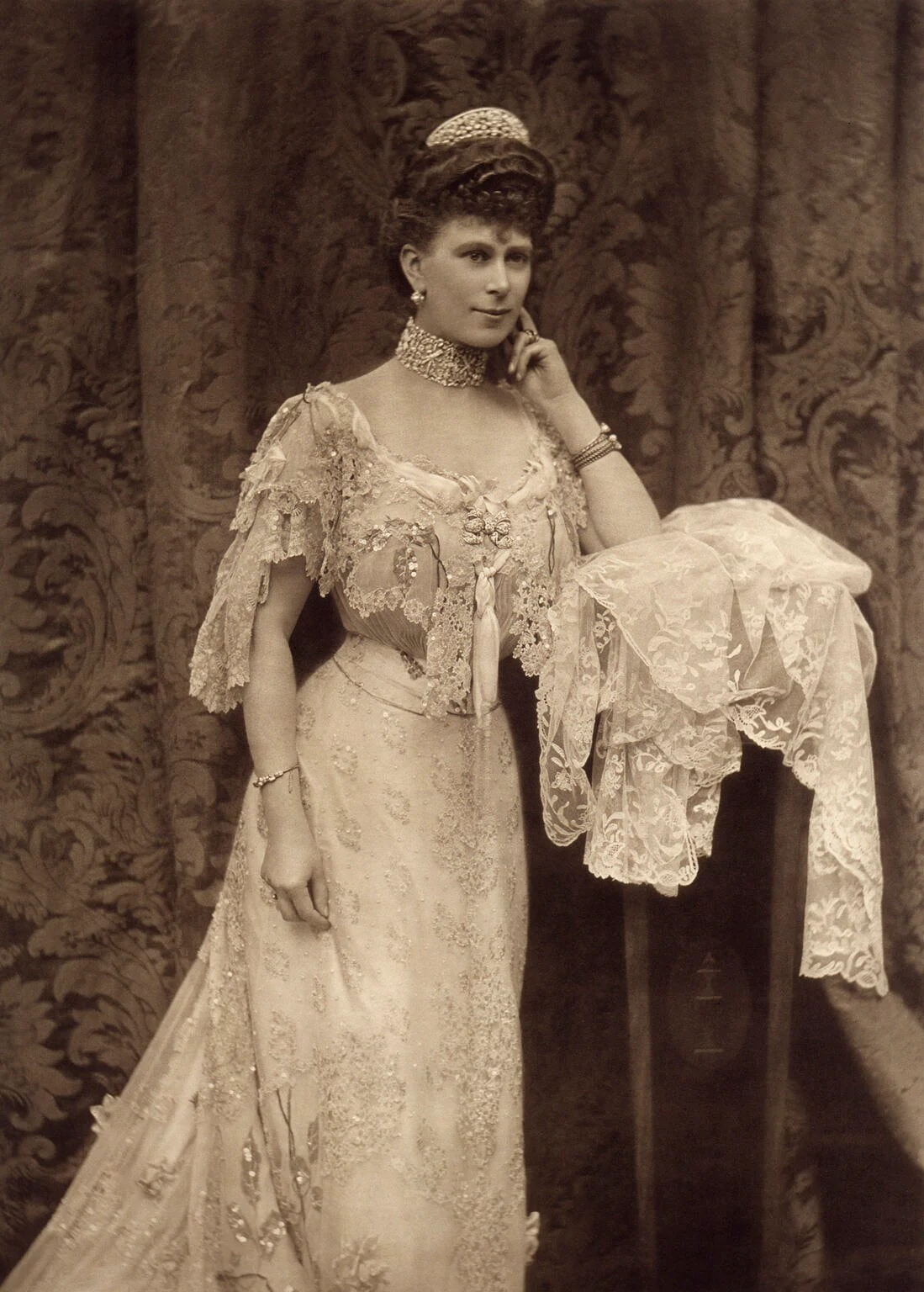
If the British royal family’s jewellery collection has a single architect, it is Queen Mary, consort of George V, and grandmother of Queen Elizabeth II. A passionate, deeply knowledgeable collector with one of the finest eyes in Europe, she spent a lifetime gathering, rescuing and reuniting jewels, and in doing so shaped the collection the family still draws on today.
Mary of Teck: modest origins, grand ambitions
Princess Victoria Mary of Teck was born in Kensington Palace in 1867, but her early life offered little of the security that address might suggest. Her father, Francis, Duke of Teck, belonged to a minor German royal house, the House of Württemberg, and held a title that carried prestige without the fortune to match it. Her mother, Princess Mary Adelaide, was a granddaughter of King George III, generous of spirit and famously generous of girth, beloved by the British public but perpetually in debt. The family’s finances were so strained that they were obliged to spend several years living on the Continent simply to reduce their expenses.
It was an unusual formation for a future queen. Mary grew up acutely aware of her position: connected to the great houses of Europe but not quite of their inner circle. She responded by educating herself with unusual thoroughness. She read voraciously, studied languages, visited museums and galleries wherever the family’s wanderings took them, and developed an early and serious interest in the decorative arts, antiques, and the material history of royal Europe. By the time she returned to England, she possessed a cultural formation that would have been remarkable in any woman of her era. In a royal consort, it proved extraordinary.
An unusual path to the altar
Mary’s route to the throne was as unconventional as her background. In 1891, she was engaged to Prince Albert Victor, Duke of Clarence, the eldest son of the Prince and Princess of Wales, and first in line to succeed his father. It was a suitable match; the Teck family were delighted. Then, in January 1892, Albert Victor died of influenza-related pneumonia at just twenty-eight years old. Mary was left a mourning fiancée, her prospects suddenly uncertain.
What followed was one of the stranger chapters in royal history. Within little more than a year, it became clear that the family considered Mary an eminently suitable match for the second son, Prince George, now heir to his father. Whether Mary herself required much persuasion is a matter of historical debate; she and George appear to have developed a genuine warmth, and their eventual marriage in 1893 proved, by all accounts, a devoted one. But the circumstances gave their union a quality that set Mary apart from the beginning: she came to her role through grief and adaptation, qualities that would define her character as queen.
A formidable personality behind a proper exterior
Those who did not know Queen Mary well sometimes found her forbidding. She was reserved to the point of appearing cold, erect in her bearing, precise in her speech, and immovable in her sense of what was correct. She did not make small talk easily. Nor was she a demonstrative mother; her children later recalled a distance that caused them real pain.
But behind the propriety was a woman of considerable intellectual force and deep feeling. She was, by any measure, one of the best-read members of the royal family in the twentieth century, with a particular passion for British and European royal history. She cared intensely about the continuity of dynasties, the preservation of traditions, and the integrity of the historical record. She kept detailed personal diaries throughout her life. And she brought to her role as queen consort a sense of purpose and professionalism that was genuinely unusual for the era. She understood that a queen had a public function, and she fulfilled it with unflinching dedication even when personal circumstances were painful.
It is this combination, rigour, historical imagination, and a deep emotional investment in royal continuity, that explains what she did with jewellery.
Jewellery as history: the meticulous records
For Queen Mary, a jewel was never merely an ornament. It was an object with a provenance, a story, and a place in a larger historical narrative. She approached the royal collection with the instincts of a curator: she kept detailed records of each significant piece, noting its origins, its previous owners, and any resettings or alterations made under her direction.
And she did have pieces altered, frequently. Mary was quite willing to dismantle an older setting and have a stone or a suite remounted in a more contemporary style, or to combine elements from different sources into a single piece. What set her apart from a merely acquisitive collector was that she documented these decisions. When she had the Cambridge emeralds set into the Vladimir Tiara, she noted precisely what had been done and why. When she acquired pieces from exiled royals and had them adapted, she recorded the original form. The notes she left behind are a significant part of what makes the collection legible today.
Buying from other royal houses: the Romanov rescue
Mary’s great opportunity, poignantly, came from the misfortunes of others. The upheavals of the early twentieth century, above all the Russian Revolution of 1917, sent exiled royals to London needing to sell. Mary, a genuine connoisseur of Russian jewellery, was ready to buy.
Most famously, in 1921 she purchased the Vladimir Tiara from the daughter of Grand Duchess Maria Pavlovna of Russia, after it had been smuggled out of the country in circumstances that read like a thriller: concealed, carried across borders, and eventually brought to safety in the West. The tiara, a magnificent frame of interlaced circles set with diamonds and originally hung with pearls, was one of the finest pieces to survive the revolution. Mary saw it, understood its significance, and acquired it.
She did not stop there. Smaller pieces from the Romanov world passed through her hands over the years: brooches, pendants, and jewelled objects that had belonged to members of the imperial family, now quietly sold by relatives who had escaped with little else. Among the acquisitions associated with this period are pieces connected to Empress Marie Feodorovna, the Danish-born consort of Tsar Alexander III, who was herself the sister of Queen Alexandra. Mary moved carefully and knowledgeably through this melancholy market, preserving treasures that might otherwise have been broken up and lost.
Keeping the family’s jewels in the family: the Cambridge emeralds
She was equally determined that her own family’s heirlooms should not scatter. The Cambridge emeralds, a suite of magnificent green stones that had come down through her mother’s family, the Cambridges, presented exactly the kind of problem Mary found intolerable. When they ended up with the mistress of her late brother, Francis, Duke of Teck, Mary moved to recover them, reportedly paying considerably more than the estimate to return the stones to the family.
The emeralds had an interesting history of their own, having arrived in England from the Continent through the Cambridge line, part of the inheritance of the family that Mary’s mother had come from. She treated them as heirlooms that belonged, morally if not legally, to the broader family patrimony. Once recovered, she made a characteristically bold decision: fifteen of the emeralds were set as drops in the Vladimir Tiara, marrying a Russian imperial frame to a German-inherited gem. The result is one of the most storied pieces in the current royal collection, worn by Elizabeth II and now by Queen Camilla.
Queen Mary’s jewellery style: layered, grand, unmistakable
It would be a mistake to think of Mary purely as an archivist. She also loved wearing jewellery, lavishly, unapologetically, in the grand manner of the Victorian and Edwardian court in which she had come of age. She was famous for her layered look: multiple strands of pearls, a constellation of brooches pinned across a shoulder or bodice, tiaras worn high and straight above her famous upswept hair. She had a particular love of large, statement pieces (the bigger the brooch, the better) and wore her jewels with a confidence that read as regal authority.
Photographs of Mary at formal occasions show a woman draped in stones, and yet the effect is never quite gaudy. She had an instinct for proportion and context, knowing what suited a state occasion, a family gathering, or a garden party. The brooches were perhaps her greatest passion. She collected them eagerly, commissioned them, acquired them, and wore them in combinations that became her signature.
Her gift to Queen Elizabeth II
Queen Mary died in March 1953, just weeks before the Coronation of her granddaughter, Queen Elizabeth II. She had wanted to see Elizabeth crowned; she did not quite manage it. But her gift to the new queen was immense.
Mary bequeathed to Elizabeth a remarkable collection of pieces, including the Girls of Great Britain and Ireland Tiara, a jewel she had herself received as a wedding gift in 1893, and which became one of Elizabeth’s most-worn diadems, the one that appears on British banknotes and coinage. She left the Lover’s Knot Tiara, originally commissioned by Queen Victoria, which came to Mary and then to Elizabeth, and which later became a favourite of Diana, Princess of Wales. Numerous brooches, pendants, and suites also passed to Elizabeth directly, forming the backbone of what the Queen drew on for seventy years of public life.
A legacy evaluated: what she saved
It is worth pausing to consider what the royal collection might look like without Queen Mary’s interventions. The Romanov pieces might have been dismantled and sold stone by stone. The Cambridge emeralds might be in private hands, unrecorded. The Vladimir Tiara might have been broken up. A great many brooches, chains, and suites that now appear at state occasions, investitures, and royal weddings might simply not exist as coherent objects.
Mary’s decisions, to buy, to record, to preserve, to reunite, were not inevitable. They required money, knowledge, and a fierce sense of purpose. She understood that the royal collection was not personal property but historical inheritance, held in trust for the institution and the nation, and she treated it accordingly.
The custodian of beauty and history
When you see the Princess of Wales in the Lover’s Knot, or the Vladimir Tiara worn at a state banquet, or the Girls of Great Britain tiara glinting from a portrait or a banknote, you are seeing Queen Mary’s legacy at work. She did not merely wear the royal jewels; she assembled them, rescued them, documented them, and ensured that they would endure.
In an era when so much of royal Europe was swept away (thrones toppled, fortunes dispersed, heirlooms scattered) Mary stood against the tide with a collector’s eye and a custodian’s determination. She was reserved, exacting, and sometimes formidable. She was also, by any measure, indispensable. The jewellery collection that glitters through every royal occasion today is, in no small part, her life’s work.
Details of royal jewels and their acquisition are drawn from widely published accounts; some specifics vary between sources.
Frequently asked questions
Who was Queen Mary?
Queen Mary (1867 to 1953), born Princess Victoria Mary of Teck, was the wife of King George V and grandmother of Queen Elizabeth II. She served as Queen consort from 1910 until George V’s death in 1936, and is regarded as one of the most formidable and influential royal consorts in British history.
Why is Queen Mary so associated with royal jewellery?
Queen Mary was a lifelong collector and curator of the royal jewellery collection. She bought pieces from exiled European royals, recovered family heirlooms, kept meticulous provenance records, and bequeathed a vast number of significant pieces to her granddaughter Queen Elizabeth II. Her decisions shaped the collection as it exists today.
What is the Vladimir Tiara, and how did Queen Mary acquire it?
The Vladimir Tiara is a spectacular diamond tiara originally made for Grand Duchess Maria Pavlovna of Russia. After the Russian Revolution, it was smuggled out of the country, and in 1921 Queen Mary purchased it from the Grand Duchess’s daughter. Mary later added Cambridge emeralds as drops, creating the version worn by Elizabeth II and now Queen Camilla.
What are the Cambridge emeralds?
The Cambridge emeralds are a suite of fine green gemstones that passed down through the Cambridge branch of the royal family. After they left family hands, Queen Mary bought them back and later had fifteen of the emeralds set into the Vladimir Tiara, combining them with the Russian imperial frame.
What tiara did Queen Mary leave to Queen Elizabeth II?
Queen Mary left several tiaras to Elizabeth II, most notably the Girls of Great Britain and Ireland Tiara, her own 1893 wedding gift, and the Lover’s Knot Tiara, which was also later worn famously by Diana, Princess of Wales. Both remain central to the royal collection.
Was Queen Mary’s first engagement to someone other than King George V?
Yes. Mary was first engaged to Prince Albert Victor, Duke of Clarence, eldest son of the Prince of Wales. He died of pneumonia in January 1892, before the wedding. Mary later became engaged to his younger brother, Prince George, whom she married in 1893.
How did Queen Mary’s background influence her approach to collecting?
Mary grew up in a minor German royal family with limited finances, which gave her both an outsider’s appreciation for royal heritage and a determined drive to preserve it. Her extensive self-education in history, art, and the decorative arts gave her the knowledge to be a genuinely expert collector rather than a merely enthusiastic one.
What was Queen Mary’s signature jewellery style?
Queen Mary was known for layering jewellery generously: multiple pearl strands, clusters of brooches, and tiaras worn high and upright above her characteristic upswept hair. She favoured large, statement pieces and was especially passionate about brooches, wearing them in combinations that became her unmistakable personal style.


