Queen Elizabeth II's Enduring Sense of Style
Block colour, a trusted handbag and brooches with hidden meaning: the quiet genius of the late Queen's lifelong wardrobe.
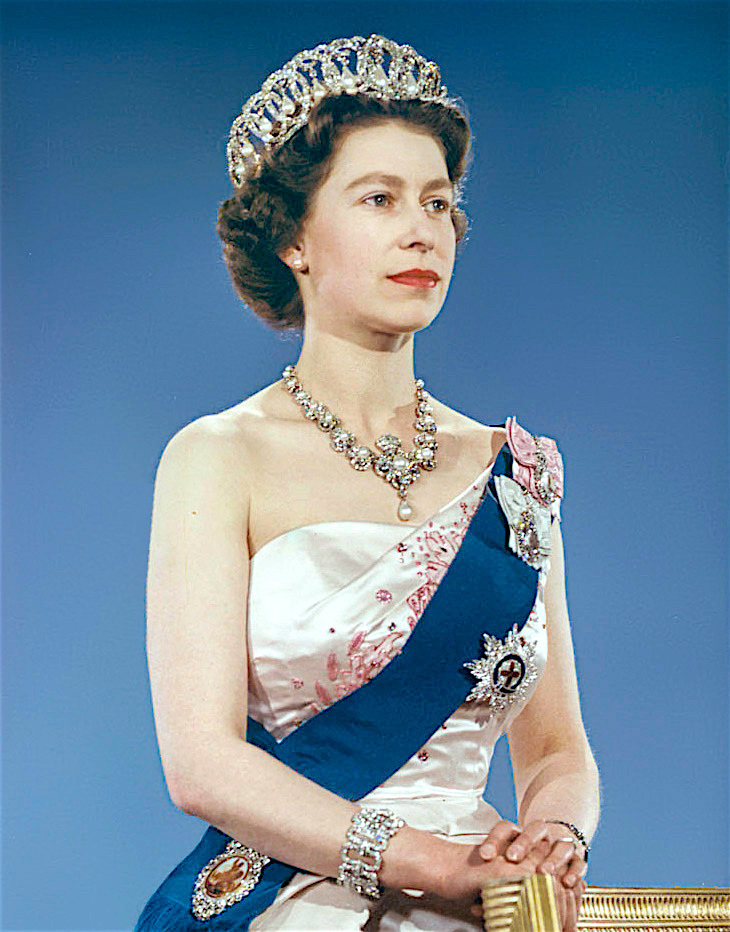
Queen Elizabeth II dressed, for more than seventy years, with a consistency that became a kind of genius. Hers was never fashion for its own sake. It was a wardrobe built to do a job, and to do it with grace. Looking back, the late Queen’s style still teaches a quiet lesson in dressing with purpose.
A wardrobe born in austerity
The late Queen’s relationship with clothes began in the years of post-war scarcity, when even royal households navigated rationing. Princess Elizabeth, like every British woman of the era, accumulated clothing coupons, a fact that her household took seriously, and which earned admiring comment from a public that appreciated the gesture. It was a formative lesson in restraint, and one that never entirely left her.
When the time came to commission a gown for the Coronation in June 1953, the choice of designer fell to Sir Norman Hartnell, a name already synonymous with royal occasion. Hartnell had dressed the Queen Mother with distinction, and his vision for the Coronation gown proved breathtaking: ivory silk satin, hand-embroidered with the floral emblems of the United Kingdom and Commonwealth nations. The Tudor rose, the Scottish thistle, the Welsh leek, the Irish shamrock, and flowers representing Canada, Australia, New Zealand, South Africa, India, Pakistan, Ceylon and Southern Rhodesia. Every stitch carried meaning, and the gown announced, from the very first day of the reign, that this Queen’s clothing would always speak a larger language.
The trusted dressmakers
Hartnell remained a pillar of the royal wardrobe for decades, his formal structures and rich fabrics well suited to the ceremony-heavy early years of the reign. Alongside him came Sir Hardy Amies, a Savile Row tailor whose sharper, more architectural sensibility shaped the Queen’s daywear through the 1950s, 60s and 70s. Together, the two men established the signature vocabulary: tailored coat dresses, structured skirts at a modest length, and that essential commitment to neatness under any circumstance.
Later decades brought new names into the dressing room. Stewart Parvin brought a lightness and a warmth of colour that suited the Queen beautifully into the 2000s. But the figure who came to exercise the greatest influence on the final chapter of the royal wardrobe was Angela Kelly, who joined the Household in 1994 and rose to become Personal Assistant, Senior Dresser and close confidante. Kelly’s role was not merely practical; she co-designed outfits, managed the enormous logistics of dressing for a punishing schedule, and understood better than almost anyone what the Queen needed her clothes to achieve.
Colour with purpose
The Queen’s love of bold, single-colour outfits (sunshine yellow, hot pink, vivid green) was famously practical. As she is reported to have understood, in a crowd of thousands, everyone wants to see the monarch; a bright block of colour made her unmistakable. It was thoughtfulness disguised as cheerfulness.
What is less widely appreciated is the planning that went into those choices. Angela Kelly has described a meticulous system: outfits photographed and catalogued, colours logged against occasions, and careful thought given to avoiding unintentional repetition or, importantly, choosing a shade that might carry unintended associations in a host country. Colour was never arbitrary. The Queen wore emerald green for Ireland, red for Canada’s national day, bright yellow in the Caribbean sunshine. The cheerfulness was real; so was the calculation.
The palette itself evolved with the reign. Soft pastels gave way to stronger, more saturated hues as the Queen found her confidence and as television screens, and later digital photography, rewarded clarity and contrast. By the final decades, a brilliant cobalt or a luminous coral could stop an entire crowd.
The art of the hat
Few people have worn a hat as faithfully, or as well. The Queen’s hats were designed to frame the face without hiding it, with brims turned back so crowds and cameras could always see her. Across the decades they became a signature as recognisable as any crown.
The royal millinery roster was distinguished. Philip Somerville created some of the most elegant hat silhouettes of the middle reign years; Frederick Fox brought wit and engineering precision to styles that sat immaculately through the longest of engagements; and in later years Rachel Trevor-Morgan, appointed Royal Milliner in 2012, worked within a well-established language while keeping it fresh.
The turned-back brim was not merely aesthetic preference. It was protocol solved by design. A hat brim angled away from the face means that when the Queen stepped out of a car, bent to speak to a child, or turned to acknowledge a crowd, nothing fell forward to interrupt the connection between monarch and people. The matching coat-and-hat formula completed the effect: a single unified presence, easily read at distance, entirely coordinated, and wholly her own.
A handbag that did its duty
The Queen carried her handbags, for many years by the British maker Launer, everywhere, and they were as functional as they were elegant. Founded in 1941 by Sam Launer, a Czech émigré who had learned his craft in Europe, the company earned its royal warrant and held it for the remainder of the reign. The Queen’s preference ran to structured frames with a comfortable handle length, long enough to sit on the forearm, leaving both hands free for the endless work of greeting.
The handbag completed the look while also serving a quiet practical purpose: it gave the Queen something to do with her hands, and it has since been suggested that the way she held, moved or placed her bag could send a discreet signal to Household staff about how an engagement was proceeding. Whether or not every placement was deliberate, the bag was always present, always immaculate, and has since become one of the most quietly iconic accessories in royal history.
Brooches that spoke
If there was a hidden language in the Queen’s wardrobe, it was in her brooches. Drawn from an extraordinary collection accumulated over a lifetime of state gifts, family heirlooms and personal acquisitions, the piece she chose for a given day was often a small, deliberate gesture.
For a visit to Canada, she wore the Maple Leaf brooch, a diamond and platinum spray given to her mother by King George VI, passed to the Princess and worn with evident affection on every Canadian occasion. On relaxed days at Balmoral, admirers of the collection learned to look for the Grima butterfly: a sculptural, jewel-encrusted piece by Andrew Grima, worn looped into a cardigan, speaking of ease and private pleasure. For Welsh occasions, the Welsh Dragon brooch made its appearance; for South Africa, the Flame Lily brooch given during the 1947 tour. To those who knew how to read them, a brooch could say a great deal without a word being spoken.
The practicalities of dressing for duty
There is a tendency to see royal dressing as pure pageantry, but the engineering behind the Queen’s wardrobe was remarkable in its attention to function. Weighted hems were a long-standing technique: small lead weights, sewn discreetly into skirt and coat linings, ensured that a hem fell straight in the wind, that a coat did not blow open on an airfield, that the visual line remained perfect through hours of outdoor engagements. It was invisible craft in service of visible dignity.
Pockets were engineered into coat dresses where they would not break the line, practical for carrying a small handkerchief, useful for anchoring a hand on a blustery day. Gloves were chosen for their ease of removal: formal occasions demanded gloves, but the Queen shook thousands of hands and the gloves had to come on and off without fuss. Everything about the wardrobe was, in this sense, a problem elegantly solved.
Constancy as soft power
There is a broader truth in the late Queen’s approach to dressing. In a media landscape that rewards novelty, she practised constancy, and constancy turned out to be its own kind of power. The sight of her in a bright coat and matching hat, pearls gleaming and posture unfailing, was reassuring in a way that went beyond aesthetics. It said: I am here. I am who I was. You know me.
For seventy years, through fifteen prime ministers, countless constitutional upheavals, global crises and personal grief, that constancy held. The wardrobe was part of the message. It was disciplined, considered and entirely her own, proof that true elegance is mostly a matter of knowing exactly who you are, and dressing accordingly, every single day.
A lasting lesson
The late Queen’s style endures precisely because it was never chasing anything. Every hat was purposeful, every brooch a small communication, every block of colour a practical kindness to the thousands who wanted simply to catch a glimpse of their monarch. She dressed, always, for other people, and that, more than any single garment, is the reason her wardrobe feels so timelessly right.
Frequently asked questions
Who designed Queen Elizabeth II’s Coronation gown?
Sir Norman Hartnell created the gown for the June 1953 Coronation, embroidering it with the floral emblems of the United Kingdom and every Commonwealth nation then represented, in ivory silk satin.
Why did the Queen favour such bold, bright colours?
Bright block colours made the Queen immediately visible in large crowds and on television. Angela Kelly, her Senior Dresser, has described a detailed system of logging and planning outfits so that colours carried the right associations for each occasion and host country.
Which milliners made hats for Queen Elizabeth II?
Philip Somerville, Frederick Fox and, in later years, Rachel Trevor-Morgan (appointed Royal Milliner in 2012) were among the most significant. All worked within the distinctive turned-back-brim tradition that kept the Queen’s face visible at all times.
What is special about the Launer handbag?
Launer is a British luxury leather-goods house founded in 1941 that held a royal warrant for its handbags. The Queen favoured a structured frame with a handle length suited to sitting on the forearm, keeping both hands available for greetings.
What is the Maple Leaf brooch?
A diamond and platinum spray brooch originally given to Queen Elizabeth The Queen Mother by King George VI. It passed to Queen Elizabeth II and was worn on every Canadian engagement as a warm gesture of connection to the country.
How were the Queen’s clothes adapted for practical use?
Hems were weighted with small lead inserts to prevent them lifting in the wind; pockets were engineered into coat dresses; and gloves were selected for ease of removal to facilitate the thousands of handshakes at public engagements.
Who was Angela Kelly and what was her role?
Angela Kelly joined the Royal Household in 1994 and became Personal Assistant, Senior Dresser and close confidante to the Queen. She co-designed outfits, managed the wardrobe catalogue and played a central role in planning the colour and style choices for public engagements.
Why are the Queen’s brooches considered significant?
The Queen possessed an extraordinary brooch collection and chose pieces deliberately to honour host nations, mark anniversaries or signal personal connection, including the Maple Leaf for Canada, the Flame Lily for South Africa and the Grima butterfly for relaxed private days at Balmoral.


