Princess Diana's Enduring Style: A Fashion Legacy
From a 25-foot wedding train to the famous "revenge dress", how Diana, Princess of Wales became one of the most influential style icons the world has known.
More than a quarter of a century on, Princess Diana remains one of the most photographed and most imitated women the world has ever known. Every coat, every gown, every off-duty sweatshirt she wore became a moment, studied at the time and revisited ever since. Few figures have shaped the way an era dressed quite so completely, and fewer still have done it with such evident warmth.
What made her style endure was never simply the clothes. It was the way she used them: to put nervous strangers at ease, to mark a turning point, to quietly say something she could not say aloud. Her wardrobe charted the arc of a remarkable life, from a shy young bride to a confident, independent woman at home on any stage in the world.
This is a celebration of that legacy: the looks that stopped the room, the designers she lifted to international fame, and the influence that still ripples through royal style and the high street alike.
The wedding gown that began it all
Diana’s style story opens with one of the most watched dresses in history. For her marriage to the Prince of Wales at St Paul’s Cathedral on 29 July 1981, she wore an ivory silk taffeta gown designed by David and Elizabeth Emanuel, embroidered with thousands of tiny pearls and sequins and finished with antique lace.
Its most famous feature was the train, which reportedly measured around 25 feet, said to be the longest ever worn at a royal wedding. So vast was it that the silk had to be carefully folded to fit inside the glass coach carrying Diana to the cathedral, emerging a little creased as she stepped out before a global audience of hundreds of millions.
The gown was pure romance, and it set the tone for the fairytale that the public so badly wanted. Yet it was also the first sign of Diana’s instinct for spectacle, for understanding that a dress, on the right occasion, could speak to the whole world at once.
From shy Sloane to the world stage
In her earliest public days, Diana dressed like the gentle “Sloane” she was: ruffled blouses, sensible knitwear and soft pastels, the wardrobe of a well-bred young Englishwoman. It was approachable and pretty, and the country adored her for it.
As her confidence grew, so did her wardrobe. The fairytale ballgowns of the early 1980s gradually gave way to something sharper, sleeker and entirely her own: tailored suits, clean lines, bolder colour. Watching that evolution across the decade is like watching a young woman steadily come into her power.
By the early 1990s she had become a genuine fashion force, photographed on engagements from Washington to Tokyo. The transformation was never showy for its own sake. Each new look felt considered, a little braver than the last, and always rooted in the same easy charm that had won people over from the start.
The black sheep that captured a nation
One of Diana’s most beloved looks needed no couturier at all. In June 1981, before her wedding, she was photographed at Windsor watching polo in a red wool jumper covered in white sheep, with a single black sheep on the front. It was designed by Joanna Osborne and Sally Muir of the label Warm & Wonderful.
The jumper became an instant talking point and has been read ever since as a wink of gentle humour from a young woman finding her place. Its appeal has only deepened with time. The original, rediscovered in an attic in 2023, sold at Sotheby’s for a reported $1.1 million, described as a world record for a jumper at auction.
That a simple knitted sweater could command such a sum says everything about Diana’s reach. She made the everyday feel iconic, and turned a playful piece of British knitwear into one of the most recognisable garments of the twentieth century.
The midnight-blue velvet and a dance with Travolta
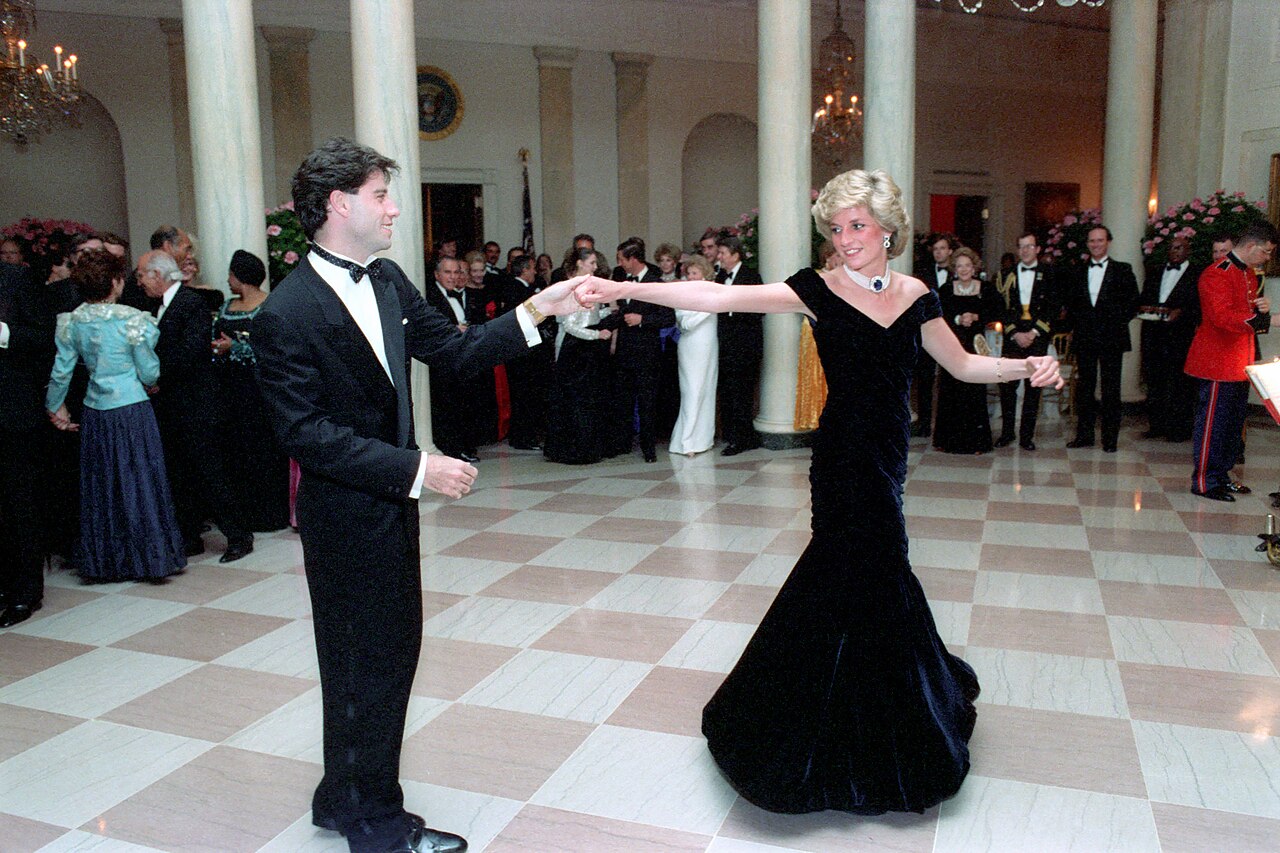
If one image captures Diana at the height of her glamour, it is the night she danced at the White House in November 1985. She wore a midnight-blue velvet evening gown by the British couturier Victor Edelstein, off-the-shoulder, elegantly cut, and unforgettable on the dance floor.
There she was twirled around the room by John Travolta, and the photographs travelled the world overnight. The gown earned its enduring nickname, the “Travolta dress”, and remains one of the most celebrated outfits she ever wore.
Its legacy carried on long after that evening. When the dress later came to auction, it reportedly sold for around £264,000, and was subsequently acquired by Historic Royal Palaces for the nation’s collection. It is a fitting home for a gown that, for one shimmering night, made a princess the most glamorous woman in any room in the world.
The “revenge dress”
No account of Diana’s style is complete without the black off-the-shoulder gown she wore on 29 June 1994. Designed by Christina Stambolian, it has gone down in history as the “revenge dress”, worn to a Vanity Fair fundraising dinner at the Serpentine Gallery in Kensington Gardens on the very evening a television documentary aired in which the Prince of Wales spoke candidly about the marriage.
Diana had reportedly owned the dress for some three years, once thinking it too daring to wear. That night she chose it, and the result was electric: a portrait of poise, independence and quiet defiance that filled the front pages and eclipsed every other story.
It remains perhaps the most famous example of an outfit saying what words need not. Decades later, designers and commentators still reach for it as shorthand for self-possession. It is proof that, in Diana’s hands, the right black dress could become a statement heard around the world.
Champion of British design
Diana’s influence was never only about how she looked; it was about whom she lifted with her. She became a devoted patron of British fashion, and the designers she favoured found themselves catapulted to international recognition almost overnight.
Chief among them was Catherine Walker, who reportedly dressed Diana more than any other designer across some sixteen years, supplying everything from sculpted day suits to her grandest evening gowns. Bruce Oldfield, whom she came to know through her charity work, dressed her in glamorous couture through the mid-1980s and into the 1990s. Victor Edelstein gave her that midnight-blue velvet triumph.
Through choices like these, Diana raised the profile of British fashion across the world. She understood the soft power of her wardrobe, and she used it generously, turning her patronage into a genuine boost for the country’s design talent and its standing on the global stage.
A style echoed by a new generation
Diana’s influence did not end with her. It lives on most visibly in the Princess of Wales, who has been seen to pay graceful tribute to her late mother-in-law more than once. In recent years Catherine has worn looks widely read as nods to Diana, among them tailored navy coat dresses with crisp white detailing, recalling the structured suits Diana wore on engagements in the mid-1990s.
These are never mere copies but thoughtful reinterpretations, modernised for a new era while honouring the woman who set the template. The thread of continuity is unmistakable, and royal-watchers delight in spotting it.
Beyond the palace, her off-duty looks feel startlingly current. Cycling shorts paired with an oversized sweatshirt, a sharp blazer thrown over jeans, a baseball cap and trainers: these “Diana off-duty” outfits are endlessly revisited on the runway and the high street, reborn for each new generation that discovers her.
A legacy beautifully worn
Diana’s enduring appeal lies in a rare combination of glamour and warmth. She dressed beautifully, but she always looked like someone you would want to know, and that, more than any single gown, is why her style has never gone out of fashion.
Her wardrobe told the story of a life lived in full view, and told it with grace, humour and courage. From the pearl-strewn wedding gown to the black dress that needed no explaining, every look added a chapter, and together they form one of the most beloved style legacies of all.
Browse our Royal Style & Fashion stories to discover more of the looks and jewels that capture the world’s attention.
Frequently asked questions
Who designed Princess Diana’s wedding dress?
Princess Diana’s 1981 wedding dress was designed by David and Elizabeth Emanuel. The ivory silk taffeta gown was embroidered with thousands of pearls and sequins and featured a dramatic train reportedly measuring around 25 feet, said to be the longest in royal wedding history.
What was Princess Diana’s “revenge dress”?
The “revenge dress” was a black off-the-shoulder evening gown by Christina Stambolian, worn by Diana on 29 June 1994. She wore it to a Serpentine Gallery dinner the same evening a documentary aired in which the Prince of Wales discussed their marriage, and it became an instant symbol of confidence and independence.
What is the story behind the black sheep jumper?
The black sheep jumper was a red knit covered in white sheep with one black sheep, made by the label Warm & Wonderful and designed by Joanna Osborne and Sally Muir. Diana first wore it watching polo in June 1981, and the rediscovered original later sold at Sotheby’s for a reported $1.1 million.
Which designers did Princess Diana favour?
Diana was a leading champion of British design, and Catherine Walker reportedly dressed her more than any other designer. She also wore couture by Bruce Oldfield and Victor Edelstein, helping to raise the international profile of British fashion through her patronage.
What was the “Travolta dress”?
The “Travolta dress” was a midnight-blue velvet gown by Victor Edelstein, worn by Diana to the White House in November 1985, where she danced with the actor John Travolta. The gown later reportedly sold at auction for around £264,000 and was acquired by Historic Royal Palaces.
How much have Princess Diana’s dresses sold for at auction?
Her dresses have set records at auction. The black sheep jumper reportedly fetched around $1.1 million at Sotheby’s in 2023, while the midnight-blue “Travolta” gown is reported to have sold for about £264,000. Such prices reflect Diana’s lasting cultural and fashion significance.
Does the Princess of Wales channel Diana’s style?
Yes. Catherine, the current Princess of Wales, has worn looks widely interpreted as tributes to Diana, including tailored navy coat dresses with white detailing that echo Diana’s structured 1990s suits. These reinterpretations honour Diana’s legacy while bringing it into a new era.
Why does Princess Diana’s style still matter today?
Diana’s style endures because it blended genuine glamour with warmth and approachability. She used fashion to connect with people, championed homegrown designers, and created looks, from gowns to off-duty separates, that continue to inspire designers, royal-watchers and the high street decades on.
Sources: Wikipedia (Wedding dress of Lady Diana Spencer; Revenge dress); Sotheby’s and ABC News on the black sheep jumper auction; CNN and Kerry Taylor Auctions on the Victor Edelstein “Travolta” dress; Marie Claire UK and Newsweek on Catherine Walker and Bruce Oldfield; HELLO! Magazine on the Princess of Wales’s tributes to Diana. Some details are reported figures and should be read as such.


