Ede & Ravenscroft: London's Oldest Tailor and Royal Robemaker
Since 1689, Ede & Ravenscroft has dressed the Crown at every coronation, robed the courts of England and Wales, and gowned graduates at universities across the world.
On the morning of 22 September 1761, the pages of London’s newspapers were full of the details of George III’s coronation at Westminster Abbey. What they did not record — because it was simply understood — was that the crimson velvet robes worn by the new King had been made by the firm at Holywell Street that had been clothing coronations since the reign of William III. They had used thirty-six yards of that velvet, one hundred and sixteen yards of broad gold lace, and enough ermine to trim a monarch. The bill would have been considerable. The trust earned was incalculable.
That firm is Ede & Ravenscroft, and it has been dressing the Crown ever since. Founded in 1689, it is London’s oldest tailor — a quiet constant across more than three centuries of British history. It has dressed thirteen sovereigns at thirteen coronations, supplied the wigs that barristers still wear in court today, and gowned graduates at more than four-fifths of British universities. And it does all of this from an address in Chancery Lane that it has occupied since 1868.
Not every great British institution announces itself loudly. Some simply continue.
London’s Oldest Tailor: The 1689 Beginning
The business was founded in 1689 by the Shudall family — a husband-and-wife tailoring partnership whose first commission was the coronation robes for King William III and Queen Mary II. It was an extraordinary start: before the firm had established any reputation, it was already dressing the Crown. That single commission set the pattern for the next 335 years.
The Shudalls were based on Holywell Street, a thoroughfare since absorbed into the Strand and Aldwych, that was then the beating heart of London’s tailoring trade. From those premises they built the foundations of what would become the most decorated ceremonial outfitter in the country, attending each successive coronation as quietly and inevitably as the Abbey itself.
William Shudall died in 1757; Martha continued the business and partnered with Francis Stone for the coronation of George III in 1761. When Martha retired in 1770, Stone carried on, and the lineage passed to his son-in-law William Webb, and then to Webb’s apprentice Joseph Ede, who joined the firm in 1811 and received his first Royal Warrant — from King William IV — in the early 1830s.
The Name on the Door: Wig, Needle and Thread
The Ravenscroft half of the partnership arrived through a different door entirely. In 1822, Humphrey Ravenscroft — from a separate wig-making family established on Serle Street since 1726 — patented a barrister’s tie wig made from white horsehair that required no powdering, no daily oiling, and no arduous curling. It was a quietly revolutionary object. Before the Ravenscroft patent, maintaining a legal wig was a daily discipline; afterwards, it was simply a matter of putting it on. The design has not been materially altered since.
The two families were eventually united in the most literal sense. In 1871, Joseph Webb Ede — son of Joseph Ede, by then installed at 93 Chancery Lane — married Rosanna Ravenscroft, daughter of wigmaker Burton Ravenscroft. Robemaking and wigmaking, once neighbouring crafts, became a single firm. The name Ede & Ravenscroft appeared in 1902 and has remained on the door ever since.
It is the kind of founding story that British institutions do especially well: a long, slow accumulation of craft, family, trust, and occasion, until the name becomes inseparable from the thing itself.
Thirteen Coronations: Dressing the Crown
No other firm has robed as many British monarchs. Ede & Ravenscroft has attended every British coronation since 1689 — thirteen in total. The details from each are a study in the materials of British ceremony: crimson silk velvet, purple silk velvet, gold lace, Canadian ermine, hand-embroidered monograms, the weight of train after train carried into the Abbey at Westminster.
For the coronation of Queen Elizabeth II on 2 June 1953, the firm made the Robe of State in crimson velvet lined with Canadian ermine, its velvet hand-woven by Warners of Braintree, Essex. The purple Robe of Estate featured a six-yard train embroidered by the Royal School of Needlework with crowned E II R monograms and sheaves of wheat — a piece of craftsmanship that took months to complete.
For the coronation of King Charles III on 6 May 2023, the approach was deliberately different. In keeping with His Majesty’s commitment to sustainability, the firm’s principal role was one of conservation rather than new creation. King George VI’s 1937 crimson velvet Robe of State was carefully conserved and adjusted to fit the new King; his 1937 purple silk velvet Robe of Estate was similarly restored. For Queen Camilla, Ede & Ravenscroft made a new purple velvet Robe of Estate, hand-embroidered by the Royal School of Needlework with the national emblems of all four nations, the Queen’s cypher, and twenty-four plants of personal significance — lily of the valley, myrtle, cornflowers, oak leaves. It was also the first coronation robe ever to feature insects: bees, butterflies, a beetle, and a caterpillar worked into the gold embroidery. A small, lovely detail; entirely in character for a firm that understands that the greatest ceremonies reward the closest attention.
The Wig That Changed the Law
Walk through the doors of 93 Chancery Lane and you are on the doorstep of the Inns of Court. That proximity is not accidental. Ede & Ravenscroft has supplied the English and Welsh legal profession with its formal dress for more than three centuries, and it dominates that market to a degree almost without parallel in any British trade.
The barrister’s bar wig — the tied horsehair wig worn in Crown Court criminal trials, the Court of Appeal, and certain High Court divisions — is still made to Humphrey Ravenscroft’s 1822 design, in the basement wig room at Chancery Lane, using methods largely unchanged in two hundred years. White horsehair from horses’ manes (finer than tail hair) is washed, graded by colour, woven, and coiled. A barrister’s bar wig takes approximately three weeks to make. A full-bottomed wig — the cascading ceremonial piece reserved for the formal opening of the legal year and a judge’s swearing-in — takes up to two months and is priced at around £2,500. By the 1970s, the firm was producing seven hundred lawyers’ wigs a year.
The wigs have attracted their share of famous admirers. In January 2015, before her appearance at the European Court of Human Rights in Strasbourg, Amal Clooney was asked by a journalist what designer she was wearing. Her reply: “I’m wearing Ede & Ravenscroft.” The quote circled the world by nightfall.
Chancery Lane: A Shop Between Two Worlds
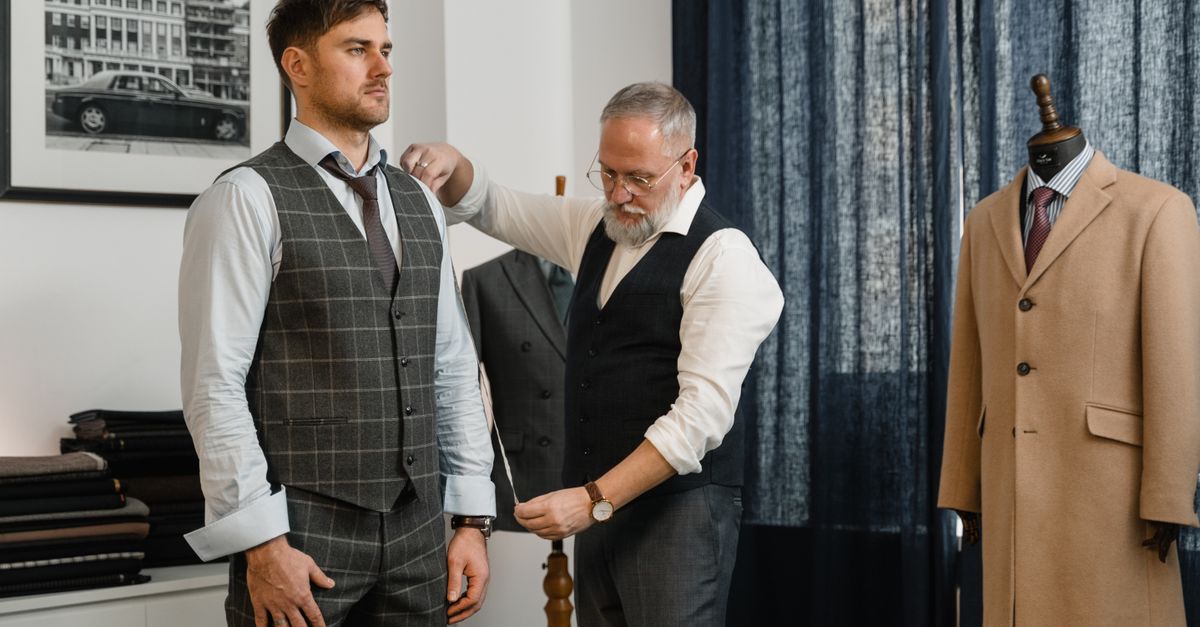
The address — 93 Chancery Lane, WC2A 1DU — is one of the more evocative in London. The firm has occupied it since 1868, and it sits at the boundary between the legal world of the Inns of Court and the commercial life of the City. On one side: barristers and judges, robes and wigs. On the other: tailored suits, morning dress, and the quiet fittings of those who need to dress for great occasions.
Today the firm operates from several London addresses. The menswear and legal atelier remains at 93 Chancery Lane; a womenswear boutique at number 92 carries designer names including Emporio Armani, Max Mara, and Paul Smith; and a third London presence on Savile Row at Burlington Gardens serves ready-to-wear and tailoring clients from Britain’s most celebrated tailoring street. Beyond London, there are outposts in Cambridge, Oxford, and Edinburgh, each serving the universities and legal communities of their respective cities.
Gowning a Nation: The Academic Dress Business
Beyond the court and the coronation lies a third great institution that Ede & Ravenscroft quietly dominates: the British university. For the 2018–19 academic year, the firm supplied academic dress for 80.5% of universities in the United Kingdom — a figure confirmed by the Competition Appeal Tribunal in a 2022 judgment brought by rival suppliers. The Tribunal dismissed the claim of anti-competitive conduct in full, but the market share figure stands as a remarkable measure of how thoroughly the firm’s robes have become the default uniform of British academic achievement.
Their relationship with the University of London dates to 1906, when they were appointed official robemakers by the Senate. They have since extended that reach internationally — hire services and physical stores in Australia, Nigeria, Hong Kong, the United States, and Ireland — following the worldwide export of the British university tradition, gown by gown.
Royal Warrants: A Continuous Thread Through the Reign
Royal Warrants have accompanied Ede & Ravenscroft since Joseph Ede received his first appointment in the 1830s. The firm has held warrants from King William IV, Queen Victoria, King Edward VII, King George V, King Edward VIII, King George VI, Queen Elizabeth II (including a separate tailoring warrant added in 2012, giving the firm four simultaneous warrants in its Elizabeth II peak), and Prince Philip, Duke of Edinburgh.
Under the reign of His Majesty The King, the firm holds two active Royal Warrants: one from King Charles III and one from Queen Camilla, both confirmed in the 2024 Royal Warrant List, for robe making and tailoring. They are listed on the Royal Warrant Holders Association website at royalwarrant.org.
For a firm that has dressed the monarch at every coronation since the Glorious Revolution, the warrant is less an accolade than an acknowledgement of what has always, quietly, been true.
Why It Still Matters
There is a particular kind of British institution that does not seek the limelight because it does not need to. The names change on the throne; the centuries stack up; and Ede & Ravenscroft continues to do what it has always done — measure carefully, cut precisely, and deliver something that will be worn at moments that matter.
The firm’s persistence is its own form of elegance. In an era that prizes disruption, there is something quietly radical about a business that has simply kept going: thirteen coronations, three centuries of law terms, generations of graduations, a name stitched so thoroughly into the fabric of British ceremony that to pull it out would be to unpick something essential. Not every institution that deserves to endure does. This one has.
Details of Royal Warrants and the firm’s history are correct as of 2026; for the current warrant status, see royalwarrant.org. For current wig prices and academic dress services, see edeandravenscroft.com.
Frequently Asked Questions
When was Ede & Ravenscroft founded?
Ede & Ravenscroft was founded in 1689 by the Shudall family, whose first commission was the coronation robes for King William III and Queen Mary II. It is London’s oldest tailor. The firm took the Ede & Ravenscroft name in 1902, when the tailoring and wig-making sides of the business were formally united.
Does Ede & Ravenscroft hold a Royal Warrant?
Yes. As of 2026, Ede & Ravenscroft holds two active Royal Warrants: one from King Charles III and one from Queen Camilla, both for robe making and tailoring, confirmed in the 2024 Royal Warrant List. The firm has held Royal Warrants continuously since the reign of King William IV in the 1830s.
How many coronations has Ede & Ravenscroft been involved in?
Ede & Ravenscroft has dressed thirteen British coronations since 1689, from William III and Mary II to King Charles III in 2023. For the 2023 coronation, the firm’s principal role was the conservation of George VI’s 1937 robes, adjusted for the King and Queen Camilla, alongside the creation of two new coronation tunics and Queen Camilla’s new Robe of Estate.
What kind of legal wigs does Ede & Ravenscroft make?
The firm makes three principal types of legal wig: the barrister’s bar (tie) wig, worn in Crown Court and appeal hearings; the judge’s bench (short) wig, worn at ordinary criminal sittings; and the full-bottomed wig, reserved for ceremonial occasions such as the formal opening of the legal year or a judge’s swearing-in. All are made by hand from white horsehair at the Chancery Lane premises, to the design patented by Humphrey Ravenscroft in 1822.
How much does an Ede & Ravenscroft wig cost?
A barrister’s bar wig costs approximately £699. A full-bottomed ceremonial wig is approximately £2,500, reflecting the two months of skilled hand labour required to make one. Both are available for purchase or hire.
Where is Ede & Ravenscroft located?
The firm’s main menswear and legal atelier is at 93 Chancery Lane, London WC2A 1DU, where it has been since 1868. There is also a womenswear boutique at 92 Chancery Lane, a Savile Row presence at Burlington Gardens, and academic dress branches in Oxford (119 High Street), Cambridge (70–72 Trumpington Street), and Edinburgh (46 Frederick Street).
Did Ede & Ravenscroft make the robes for King Charles III’s coronation?
Yes. For the 2023 coronation, Ede & Ravenscroft conserved and adjusted King George VI’s 1937 crimson velvet Robe of State and purple silk velvet Robe of Estate for King Charles III. They also made two new coronation tunics for the King, and created a new purple velvet Robe of Estate for Queen Camilla — the latter hand-embroidered with national emblems, the Queen’s cypher, and the first insects ever to appear on a British coronation robe.
What universities use Ede & Ravenscroft for academic dress?
For the 2018–19 academic year, Ede & Ravenscroft supplied academic dress for 80.5% of universities in the United Kingdom, as confirmed by the Competition Appeal Tribunal. Their relationship with the University of London dates to 1906. They maintain academic dress branches in Oxford, Cambridge, and Edinburgh, and hire and purchase services extend to graduates internationally.


