A Short History of the Royal Tiara
When they are worn, why they are so often borrowed, and what makes a tiara the most romantic jewel in the royal box.
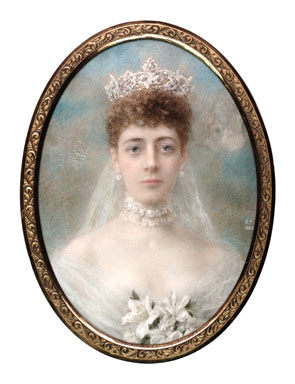
Of all the jewels in the royal collection, none captures the imagination quite like the tiara. It is the jewel of fairy tales and state banquets, of wedding mornings and grand entrances, and the rules around it are every bit as fascinating as the sparkle itself.
Ancient Origins: From Athens to Byzantium
The tiara’s story begins long before the palaces of London. In ancient Greece, the stephane, a crescent-shaped diadem of hammered gold, was worn by goddesses in sculpture and by mortal women at their most ceremonial. The Romans adopted and elaborated the form, gifting laurel wreaths and jewelled circlets to their most celebrated figures. It was in Byzantium, however, that the crown-adjacent headpiece truly became a language of power. Byzantine empresses wore jewelled loros headdresses so heavy with gold and enamel that they required attendants to support them.
When Napoleonic Europe fell in love with classical antiquity in the late eighteenth century, it reached instinctively for the tiara. The neoclassical revival, fired by the excavations at Herculaneum and Pompeii, made the Greek stephane newly fashionable, and the courts of Europe raced to commission pieces that echoed ancient forms. Napoleon himself presented Joséphine with a series of magnificent parures, and the tiara, reborn as the diadem, became the defining jewel of the imperial age. The British court was watching closely.
The Victorian Golden Age
It was the Victorian era that transformed the tiara into the jewel we recognise today. Queen Victoria’s long reign coincided with a golden age of royal jewellery commissions, as advancing techniques in gem-cutting and setting allowed jewellers to create pieces of extraordinary lightness and brilliance. The great London houses, Garrard, Collingwood, and later Cartier and Boucheron, competed to produce tiaras of increasing ambition.
Victoria herself accumulated an extraordinary collection, and the tradition of royal women receiving tiaras as wedding gifts was firmly established during her reign. Each of her daughters and granddaughters was adorned; each marriage became an opportunity for a new commission. The pieces made during this period form the backbone of the royal collection today, and many are still brought out for the grandest occasions more than a century after they were first clasped into place.
The era also produced the distinctly British taste for certain motifs: the fringe, the lover’s knot, the scroll, the floral spray. These were not merely decorative preferences. Each carried symbolic weight, expressing love, loyalty and dynastic pride in the language of precious stones.
Named Royal Tiaras and Their Stories
The most celebrated pieces in the royal collection have names, and those names carry centuries of romantic and dynastic history.
The Girls of Great Britain and Ireland Tiara was presented to the future Queen Mary in 1893 as a wedding gift, raised by public subscription from the girls and women of those nations. Mary passed it to the then-Princess Elizabeth as a wedding gift in 1947, and it became one of the most frequently worn pieces of the twentieth century: a slender, elegant circlet of diamonds in a lover’s-knot-and-scroll design that suits an enormous range of occasions. It is the tiara many associate most instinctively with the late Queen.
The Lover’s Knot Tiara, sometimes called the Cambridge Lover’s Knot, has an even more romantic provenance. Queen Mary commissioned a reproduction of a tiara originally belonging to her grandmother, Princess Augusta Caroline of Hesse, in 1913. Its design of pearl drops suspended from diamond arches is instantly recognisable, and its associations are now perhaps more sentimental than ever. It was a favourite of Diana, Princess of Wales, and has been worn in recent years by the Princess of Wales, Catherine, making it a piece that carries the weight of generations in every public appearance.
The Fringe Tiara worn by Princess Elizabeth on her wedding day in 1947 was borrowed, fittingly, from her mother, Queen Elizabeth The Queen Mother, who had herself borrowed it from Queen Mary. It was made from a necklace originally given to Queen Victoria in 1830 and converted to a tiara in 1919, exemplifying the royal tradition of reimagining pieces as tastes and occasions change. On the morning of the wedding, the tiara snapped. A royal jeweller was summoned in haste to effect a repair before the procession to Westminster Abbey, lending the piece a slightly breathless story that has never quite left it.
How a Tiara Is Made
A royal tiara is a feat of engineering as much as artistry. The finest examples are built on a framework of platinum or gold, with platinum becoming preferred through the twentieth century for its strength and its neutral colour, which allows diamonds to be mounted in settings that seem almost to disappear. The stones are held in carefully calculated tensions, each setting designed to maximise the reflection of light from every angle.
Many tiaras are built on a flexible band, sometimes called a spring band, that allows the piece to be worn either as a tiara or, when the arches are removed, as a necklace. This convertibility was prized in an age when jewellery was expected to earn its considerable expense across multiple uses. The Girls of Great Britain and Ireland Tiara, for example, was originally made to be worn as a necklace, and the conversion to a tiara came later.
Keeping a tiara in place during a long evening requires more engineering still. Jewellers work with the wearer’s hairdresser to design a structure of combs, pins and sometimes a hidden internal framework stitched into an updo. The weight of a substantial piece can be considerable, and a skilled lady’s maid was historically as important to a tiara’s success as the jeweller who made it.
The “Tiara Test” and Etiquette Nuances
The etiquette surrounding tiaras is one of the more pleasingly arcane corners of royal protocol. By long tradition, tiaras are reserved for the grandest occasions, such as white-tie events, state banquets, coronations and weddings, and are, again by tradition, the preserve of married women. The old formulation holds that a tiara signals a head that is “spoken for”: it is the jewel of the wife, not the debutante.
In practice, this rule has always been observed with some flexibility. Princesses have worn tiaras before marriage when occasion demanded, and the distinctions have softened considerably in modern decades. But the core principle, that a tiara requires a certain grandeur of setting, has endured. One does not, as royal watchers occasionally note with gentle amusement, wear a tiara to a garden party or a country weekend. There is, informally, what might be called a “tiara test”: does the occasion justify it? A state banquet at Buckingham Palace does. A reception at a foreign embassy, perhaps. A black-tie gala, sometimes. Anything less formal, and the headband stays in the vault.
The “Something Borrowed” Tradition
One of the most charming royal customs is the lending of tiaras for a wedding day. A bride marrying into the royal family is often lent a piece from the collection, a gesture that is both deeply practical (a new princess arriving with no tiara of her own) and profoundly sentimental. The choice of piece becomes, in the hands of royal watchers and journalists, a subject of the most earnest speculation, each option carrying a freight of history and meaning.
It is, quite literally, the royal “something borrowed,” and the tradition has produced some of the most memorable jewellery moments in modern history. The piece chosen is never arbitrary: it reflects the taste of the bride, the wishes of the family, and the occasion itself, and the announcement, whether made in advance or revealed at the church door, is invariably greeted with delight. In this way, an old piece of jewellery is refreshed by a new association, its story extended rather than concluded.
The Modern Royal Tiara
The tiara today occupies a curious and rather wonderful position in the wardrobe of the working royal. It appears less frequently than it once did. The occasions that demand it, the great white-tie banquets and formal state visits, are themselves rarer than in the Victorian or Edwardian heyday. But when it appears, its impact is undiminished.
The Princess of Wales has brought a particularly thoughtful approach to tiara dressing in recent years, returning again and again to pieces with strong sentimental associations and demonstrating an instinct for matching the jewel to the moment. The late Queen’s consistent wearing of the Girls of Great Britain and Ireland Tiara made it one of the most globally recognised pieces of jewellery in history. Younger members of the family are beginning to develop their own relationships with specific pieces, a process that takes years but that ultimately adds another layer to each tiara’s long and accumulating story.
Why They Still Enchant
In an age of relaxed dress codes and democratised fashion, the tiara endures precisely because it belongs to another world: one of ceremony, history and unhurried glamour. It is the jewel that connects a wearer to the women who wore it before her, to the craftsmen who made it, to the occasions that called it into being. It is not merely decorative; it is a form of continuity.
To see a tiara worn well, on the right head, at the right occasion, with the right dress, is to understand something of what monarchy still does that no other institution quite manages: it makes history present, makes the past visible, and turns an evening into something that feels, however briefly, like a fairy tale.
Details of specific pieces and their histories are drawn from widely published accounts and can vary between sources.
Frequently Asked Questions
What is the difference between a tiara and a crown?
A crown is typically a closed or semi-closed circlet associated with sovereign authority. It is worn at a coronation or as a symbol of regal power. A tiara is an open, ornamental band worn by women at formal occasions; it carries no constitutional significance. Members of the royal family wear tiaras at state banquets and weddings; the Crown Jewels, including St Edward’s Crown, are reserved for the most solemn ceremonial moments.
Why do royal brides borrow tiaras rather than buy their own?
Partly tradition, partly practicality. A new bride joining the royal family does not generally arrive with a tiara collection of her own, and purchasing or commissioning a suitable piece at short notice would be both costly and time-consuming. Being lent a piece from the royal collection is also a meaningful gesture of welcome: an invitation to wear the family’s history as one’s own. It is, in the truest sense, the something borrowed.
When are tiaras traditionally worn?
By long-established etiquette, tiaras are worn at the grandest evening occasions: state banquets, coronations, white-tie dinners and formal weddings. They are rarely, if ever, appropriate at afternoon events or occasions below black tie. The tradition also holds that tiaras are worn by married women, though this rule is observed more loosely today than in previous centuries.
How do tiaras stay on the head during long evenings?
A combination of hidden combs, pins and a carefully engineered internal framework stitched into a formal updo. A skilled hairdresser works with the tiara’s structure. Many pieces have purpose-built attachment points, and the weight is distributed as evenly as possible across the hair. For very heavy pieces, additional anchoring mechanisms may be used. A good lady’s maid was historically considered as essential as the jeweller who made the piece.
Which is the most famous tiara in the British royal collection?
This depends somewhat on one’s definition of famous. The Girls of Great Britain and Ireland Tiara is perhaps the most widely recognised, having been worn by the late Queen Elizabeth II for decades and appearing on banknotes and official portraits. The Lover’s Knot Tiara has a newer layer of fame from its association with Diana, Princess of Wales, and its more recent wearing by Catherine, Princess of Wales. The Fringe Tiara carries perhaps the most romantic single story: worn by Princess Elizabeth on her 1947 wedding day after a last-minute repair.
Can royal tiaras be converted into other jewellery?
Many historic pieces were made to be convertible. The Fringe Tiara, for instance, began life as a necklace before being adapted for the head. The Girls of Great Britain and Ireland Tiara was also originally intended to be worn as a necklace, with the tiara form added subsequently. Convertibility was prized in earlier eras because it allowed a single piece to justify its considerable expense across multiple uses. Some pieces in the royal collection can still be worn in more than one configuration.
Do male members of the royal family ever wear tiaras?
No. By convention, tiaras are exclusively worn by women. Male members of the royal family wear orders, medals, and decorations at formal occasions, and may wear crowns at coronations, but the tiara is firmly established as a piece of feminine jewellery within royal protocol.
Are there new tiaras being made for the royal family today?
Occasionally. While the existing collection is vast, pieces are sometimes commissioned or acquired, and existing jewellery is periodically reset or reimagined. The broader tradition of receiving a tiara as a wedding gift has, in various forms, continued into the modern era. The appetite for new commissions is, however, somewhat tempered by the richness of what already exists in the vault.


